Why Do I Wake Up With Knee Pain? 9 Possible Causes
Why do I wake up with knee pain? Morning knee pain may result from prolonged sleeping positions, osteoarthritis, patellofemoral pain, a meniscus injury, bursitis, tendinitis, ligament damage, inflammatory arthritis, referred pain, or—less commonly—an infection or another serious condition.
The timing of the pain offers useful clues. Stiffness that improves after gentle movement may be associated with arthritis or prolonged inactivity. Sharp pain when straightening the leg may suggest an irritated joint structure, while swelling, locking, instability, or an inability to bear weight requires closer attention.
Pain after sleeping does not necessarily mean that your mattress caused the problem. A nighttime position may aggravate tissues that were already irritated by exercise, injury, arthritis, or repetitive strain.
This guide explores nine possible answers to why do I wake up with knee pain, practical ways to reduce mild discomfort, and warning signs that require medical care.
Important: Seek urgent medical attention if you cannot move the knee or bear weight, the joint is badly swollen or deformed, or severe pain followed an injury. A hot, red knee accompanied by fever or chills may indicate an infection.
What Does Knee Pain After Sleeping Feel Like?
Morning knee pain can affect the front, back, inside, outside, or entire joint. The location may help narrow the possibilities, although it cannot confirm a diagnosis.
Symptoms may include:
- Aching around or behind the kneecap
- Stiffness when first getting out of bed
- Pain when fully bending or straightening the leg
- Tenderness along the joint line
- Swelling around the kneecap
- Warmth or redness
- Clicking, popping, or grinding
- Painful catching or locking
- A feeling that the knee may give way
- Difficulty walking downstairs
- Pain when standing from a chair
- Numbness or tingling in the lower leg
- Pain extending from the hip or lower back
- Discomfort that repeatedly interrupts sleep
Painless clicking is common and does not always indicate damage. Clicking combined with swelling, locking, instability, or persistent pain deserves an evaluation.
If the discomfort begins around the hip and travels toward the knee, compare your symptoms with Why Do I Wake Up With Hip Pain? 9 Possible Causes.
Where Is the Pain Located?
| Pain location or pattern | Possible contributors |
|---|---|
| Front of the knee | Patellofemoral pain, tendinitis, bursitis, or arthritis |
| Inside of the knee | Medial meniscus injury, ligament problem, or arthritis |
| Outside of the knee | Iliotibial-band irritation, lateral meniscus injury, or ligament problem |
| Back of the knee | Baker’s cyst, hamstring irritation, arthritis, or a blood-vessel problem |
| Entire knee with stiffness | Osteoarthritis or inflammatory arthritis |
| Joint-line pain with locking | Possible meniscus injury |
| Hot, swollen joint with fever | Possible infection |
| Pain extending from the back | Nerve compression or referred pain |
| Sudden pain after twisting | Meniscus or ligament injury |
Knee pain can also originate in the hip, lower back, muscles, nerves, or blood vessels. The exact source may require a physical examination.
When Is Morning Knee Pain an Emergency?
Most cases of knee pain after sleeping are not emergencies. However, serious injury, infection, restricted circulation, or a blood clot may require urgent treatment.
Seek urgent medical care when:
- You cannot stand or put weight on the affected leg
- The knee is badly swollen or has changed shape
- Severe pain began after a fall, collision, or twisting injury
- The knee is completely locked
- The joint repeatedly gives way
- The knee is red, hot, and swollen
- You have a fever, chills, or feel generally unwell
- The foot becomes cold, pale, or blue
- Sudden numbness or weakness develops
- Swelling extends into the calf
- Calf pain occurs with warmth or skin-color changes
Call emergency services for leg pain or swelling accompanied by chest pain, shortness of breath, coughing blood, fainting, or a rapid heartbeat.
The NHS knee-pain guidance recommends urgent assessment for a very painful knee, inability to move it or bear weight, severe swelling, deformity, painful locking, or redness and heat accompanied by fever.
1. Your Sleeping Position May Aggravate the Knee
Remaining in one position for several hours may place pressure on the knee or keep it deeply bent. This does not usually damage a healthy joint overnight, but it can aggravate arthritis, bursitis, a meniscus problem, tendon irritation, or a recent injury.
Your sleeping position may be contributing when:
- Pain is strongest immediately after waking
- The knee feels better after gentle movement
- Symptoms worsen after sleeping with the knee tightly bent
- One knee presses against the other during side sleeping
- A heavy blanket holds the leg in an uncomfortable position
- Pain changes noticeably when you alter your sleep position
- There is no major swelling, deformity, fever, or recent injury
Side Sleeping
When side sleeping, the upper knee may drop forward and rotate the hip and lower back. The knees may also press directly against each other.
Placing a supportive pillow between the knees can reduce direct contact and help keep the hips, knees, and ankles more evenly aligned. MedlinePlus includes sleeping with a pillow underneath or between the knees among its general knee-pain comfort measures.
The pillow should support both the knee and lower leg without forcing the upper leg too high. A tiny decorative cushion may look charming, but your knee is unlikely to respect its résumé.
Back Sleeping
A small pillow beneath the knees may feel comfortable when lying on your back, particularly if fully straightening the joint increases discomfort.
However, continuously keeping an injured knee bent may contribute to stiffness. People recovering from surgery or a significant injury should follow their clinician’s positioning instructions rather than experimenting with support.
Stomach Sleeping
Stomach sleeping can rotate the hips and legs while placing the kneecap against the mattress. If this position consistently worsens symptoms, temporarily changing to the back or side may help.
A sleeping-position adjustment may reduce pressure, but it cannot repair torn cartilage, a damaged ligament, advanced arthritis, or an infected joint.
2. Knee Osteoarthritis May Cause Morning Pain and Stiffness
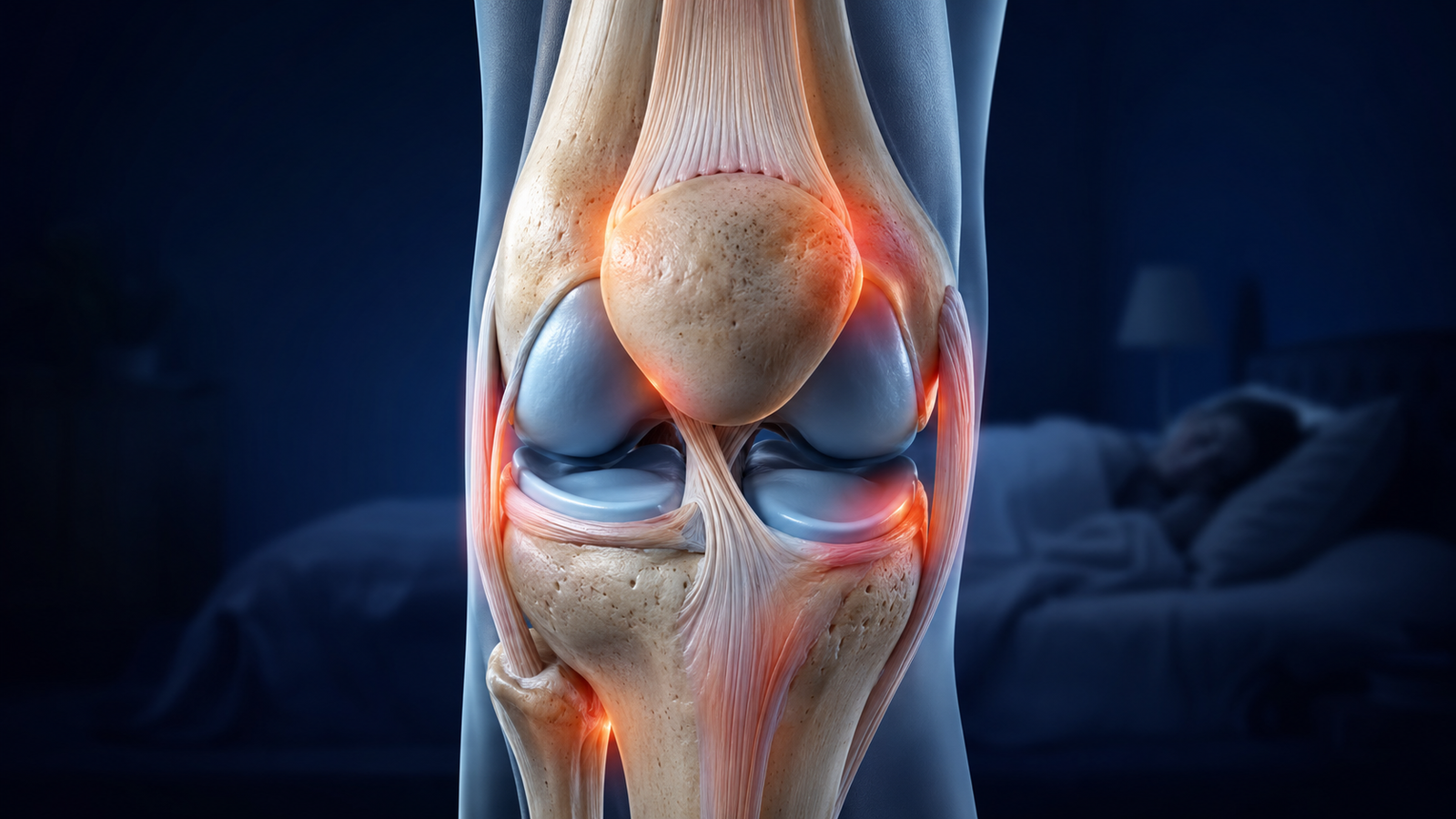
Knee osteoarthritis develops when the cartilage that helps the joint move smoothly gradually deteriorates. The condition commonly causes pain, stiffness, swelling, and reduced movement.
Possible symptoms include:
- Pain that developed gradually
- Morning stiffness
- Stiffness after sitting or resting
- Swelling around the knee
- Difficulty fully bending or straightening the leg
- Pain during walking or stair climbing
- Grinding or crackling sensations
- Pain after vigorous activity
- Weakness or buckling
- Increasing difficulty with daily activities
- Nighttime pain in more advanced cases
The American Academy of Orthopaedic Surgeons explains that knee-arthritis pain and swelling may be worse in the morning or after sitting and resting.
Why Can Arthritis Feel Worse After Sleeping?
During sleep, the knee remains relatively still for several hours. An arthritic joint may consequently feel stiff when you first bend it or place weight on it.
Sleeping with the knee deeply bent or directly pressed against the other leg may further aggravate discomfort. Symptoms often begin to improve after careful movement, although strenuous activity can cause another flare later.
Knee osteoarthritis becomes more likely with age, but risk may also increase with:
- A previous knee injury
- Repetitive joint stress
- Excess body weight
- Family history
- Leg-alignment differences
- Certain metabolic conditions
- Previous surgery or joint damage
Morning knee pain alone does not confirm osteoarthritis. A meniscus injury, inflammatory arthritis, bursitis, tendinitis, or referred pain from another area can produce similar symptoms.
When knee discomfort occurs alongside hip or lower-back pain, the related guides Why Do I Wake Up With Hip Pain? 9 Possible Causes and Why Do I Wake Up With Back Pain? 9 Causes and Solutions may help you compare the patterns.
How Is Knee Osteoarthritis Evaluated?
A healthcare professional may examine:
- Tenderness and swelling
- Knee movement
- Walking pattern
- Joint stability
- Leg alignment
- Grinding or crepitus
- Muscle strength
X-rays may show narrowing of the joint space, bone spurs, or other arthritic changes. Blood tests or additional imaging may be used when another condition is suspected.
Treatment depends on symptom severity and may include guided exercise, physical therapy, activity modification, weight management when appropriate, medication reviewed for personal safety, assistive devices, injections, or surgery for advanced disease.
3. Patellofemoral Pain Syndrome May Cause Pain Around the Kneecap
Patellofemoral pain syndrome causes discomfort at the front of the knee or around the kneecap. It is sometimes called runner’s knee, although it can affect people who do not run.
Possible symptoms include:
- A dull ache around or behind the kneecap
- Pain when climbing or descending stairs
- Discomfort during squatting, running, or jumping
- Pain after sitting with the knee bent
- Crackling or popping during movement
- Symptoms following a sudden increase in exercise
- Pain when getting out of bed or standing from a chair
- Discomfort affecting one or both knees
The American Academy of Orthopaedic Surgeons explains that patellofemoral pain commonly develops gradually and may worsen during activities that repeatedly bend the knee or after prolonged sitting with the knees bent.
Why Can It Hurt After Sleeping?
Sleeping with the knee tightly bent for several hours may make an already irritated kneecap region feel stiff. Pressure from the other knee during side sleeping or from the mattress during stomach sleeping may also increase discomfort.
Patellofemoral pain may be associated with:
- A rapid increase in exercise intensity
- Repetitive running or jumping
- Weakness or imbalance in the thigh and hip muscles
- Changes in footwear or training surfaces
- Kneecap alignment or tracking differences
- Reduced flexibility
- Previous knee surgery or injury
Pain around the kneecap does not always indicate damaged cartilage. Osteoarthritis, patellar tendinitis, bursitis, and referred pain can create similar symptoms.
Temporarily reducing activities that clearly aggravate the knee may help. A clinician or physical therapist may recommend exercises based on strength, flexibility, movement patterns, and the actual source of the pain.
4. A Meniscus Tear May Cause Locking or Joint-Line Pain
Each knee contains two menisci—firm, C-shaped pieces of cartilage that help absorb force between the thighbone and shinbone.
A meniscus can tear during a twisting movement, particularly when the foot remains planted. Degenerative tears may develop more gradually as the tissue changes with age.
Common symptoms include:
- Pain along the inside or outside joint line
- Swelling and stiffness
- Pain after twisting or pivoting
- Catching or locking
- Difficulty fully straightening the knee
- A sensation that the knee may give way
- Reduced range of movement
- A popping sensation at the time of injury
- Pain during squatting or turning
According to the American Academy of Orthopaedic Surgeons, people with a meniscus tear may initially remain able to walk, while stiffness and swelling can increase over the following two or three days.
Why May a Meniscus Problem Feel Worse in the Morning?
Overnight inactivity can make an irritated knee feel stiff. A deeply bent sleeping position may also increase discomfort in some people.
A meniscus problem may be more likely when why do I wake up with knee pain is accompanied by painful catching, locking, joint-line tenderness, or a recent twisting injury.
However, symptoms alone cannot confirm a tear. Osteoarthritis can also cause stiffness, grinding, catching, or degenerative changes within the meniscus.
When Does Locking Need Medical Attention?
Arrange an assessment when:
- The knee cannot fully straighten
- Locking occurs repeatedly
- Swelling persists or returns
- The knee frequently gives way
- Walking becomes difficult
- Symptoms followed a significant injury
- Pain is not improving
A completely locked knee, major swelling, deformity, or inability to bear weight requires urgent assessment.
Evaluation may include movement tests and an X-ray to investigate bone-related problems. MRI may be used when detailed images of the meniscus and other soft tissues are necessary.
Not every meniscus tear requires surgery. Treatment depends on the tear’s type and location, the person’s age and activity level, associated arthritis, mechanical symptoms, and response to nonsurgical care.
5. Knee Bursitis or Tendinitis May Become Stiff During Rest
Bursae are small, fluid-filled structures that reduce friction around joints. Tendons connect muscles to bones. Repetitive kneeling, running, jumping, climbing, or a sudden increase in activity can irritate these tissues.
Prepatellar Bursitis
Prepatellar bursitis affects the bursa in front of the kneecap. It is often associated with frequent kneeling or a direct blow.
Possible symptoms include:
- Visible swelling over the kneecap
- Tenderness and warmth
- Pain during kneeling
- Discomfort with movement
- Redness or skin changes
- Fever or chills if infection is present
The AAOS guide to prepatellar bursitis notes that infected bursitis may cause redness, fluid, fever, and chills and requires more urgent treatment.
Pes Anserine Bursitis
Pes anserine bursitis causes pain and tenderness on the inner side of the knee, usually slightly below the joint.
Symptoms may worsen with:
- Climbing stairs
- Running
- Repetitive exercise
- Sitting with the knee bent
- Pressing the tender area
- Getting up after prolonged rest
The American Academy of Orthopaedic Surgeons identifies slowly developing inner-knee pain, tenderness, puffiness, and stiffness after prolonged sitting as common features.
Patellar Tendinitis
Patellar tendinitis affects the tendon connecting the kneecap to the shinbone. It is commonly associated with repeated jumping, running, or rapid changes in training load.
Pain is usually located between the lower edge of the kneecap and the upper shinbone. It may initially occur only after activity and later become noticeable during stairs, squatting, sitting, or ordinary walking.
Overnight rest can make irritated tissue feel stiff, but severe morning pain should not automatically be blamed on a tendon. A stress fracture, meniscus tear, arthritis, infection, or referred pain may appear similar.
Seek medical advice when swelling is substantial, the knee is hot or red, pain affects walking, symptoms persist, or you cannot actively straighten the knee. Sudden pain with a popping sensation, bruising, and loss of knee extension may indicate a significant tendon tear.
Comparing Causes 3–5
| Possible cause | Common clues |
|---|---|
| Patellofemoral pain syndrome | Dull pain around the kneecap during stairs, squatting, or prolonged sitting |
| Meniscus tear | Joint-line pain, swelling, catching, locking, or giving way |
| Prepatellar bursitis | Visible swelling and tenderness directly over the kneecap |
| Pes anserine bursitis | Tender pain on the inner knee just below the joint |
| Patellar tendinitis | Pain below the kneecap associated with running or jumping |
| Infected bursitis | Warmth, redness, swelling, fever, or chills |
These patterns may help narrow possible answers to why do I wake up with knee pain, but overlapping symptoms are common. Persistent swelling, mechanical locking, instability, or difficulty bearing weight deserves professional evaluation.
6. A Knee Ligament Injury May Cause Swelling or Instability
Four major ligaments help stabilize the knee:
- Anterior cruciate ligament (ACL)
- Posterior cruciate ligament (PCL)
- Medial collateral ligament (MCL)
- Lateral collateral ligament (LCL)
These ligaments may be stretched or torn during a sudden change of direction, awkward landing, collision, fall, or forceful twisting movement.
Possible symptoms include:
- A popping sensation at the time of injury
- Rapid or gradual swelling
- Pain while walking
- Reduced range of motion
- Tenderness along the inside or outside of the knee
- Bruising
- Difficulty fully bending or straightening the leg
- Buckling or giving way
- A feeling that the knee is unstable
- Pain during turning or pivoting
The American Academy of Orthopaedic Surgeons notes that an ACL injury may cause pain, swelling within 24 hours, reduced movement, joint-line tenderness, and discomfort while walking.
Why Can a Ligament Injury Hurt More After Sleeping?
An injured knee may stiffen while remaining still overnight. Swelling can also limit movement, making the first few steps after waking particularly uncomfortable.
Sleeping with the knee twisted, unsupported, or deeply bent may aggravate sensitive tissues. However, nighttime positioning does not explain instability following a significant injury.
A ligament injury may be more likely when why do I wake up with knee pain is accompanied by:
- A recent sports injury or fall
- A pop during twisting or landing
- Noticeable swelling
- Repeated buckling
- Pain along one side of the knee
- Difficulty changing direction
- A feeling that the joint is loose
Avoid testing an unstable knee by repeatedly twisting, jumping, or attempting to “walk it off.” Returning to demanding activity too early may cause further injury.
Seek prompt medical assessment when the knee repeatedly gives way, swelling is substantial, walking is difficult, or symptoms began after significant trauma. An inability to bear weight, obvious deformity, loss of circulation, or a completely locked knee requires urgent care.
Evaluation may involve stability tests, X-rays to check for fractures, and MRI when detailed assessment of the ligaments, menisci, or other soft tissues is necessary. Treatment depends on the injured ligament, severity of the tear, associated damage, activity level, and degree of instability.
7. Inflammatory Arthritis May Cause Prolonged Morning Stiffness
Inflammatory arthritis occurs when immune-system activity causes inflammation within or around joints. Unlike discomfort caused mainly by pressure or overuse, inflammatory knee pain is often worse after rest and may improve as the body begins moving.
Possible clues include:
- Morning stiffness lasting longer than 30 minutes
- Swelling, warmth, or tenderness
- Symptoms affecting both knees
- Pain in several joints
- Stiffness after prolonged sitting
- Fatigue or low energy
- Occasional low-grade fever
- Reduced appetite
- Psoriasis
- Eye inflammation
- Persistent back or hip stiffness
- Recent gastrointestinal or urinary infection
Rheumatoid Arthritis
Rheumatoid arthritis is an autoimmune condition that commonly affects multiple joints. The knees may become painful, swollen, warm, and difficult to bend.
The National Institute of Arthritis and Musculoskeletal and Skin Diseases identifies joint stiffness lasting longer than 30 minutes after waking or resting as a common symptom. Pain, swelling, warmth, fatigue, and occasional fever may also occur.
Rheumatoid arthritis often produces a symmetrical pattern, although symptoms do not always begin in both knees simultaneously.
Psoriatic and Reactive Arthritis
Psoriatic arthritis may cause joint pain, swelling, fatigue, and stiffness that is worse in the morning or after rest. Some people have obvious psoriasis, while others develop joint symptoms before noticeable skin changes.
Reactive arthritis may begin after certain infections and commonly affects large joints in the lower body, including the knees and ankles. The NIAMS reactive arthritis guide notes that morning stiffness and nighttime pain can occur.
Inflammatory arthritis becomes more concerning when knee symptoms occur alongside:
- Swollen fingers or toes
- Heel pain
- Persistent lower-back stiffness
- Scaly skin patches
- Nail pitting or separation
- Red, painful, light-sensitive eyes
- Abdominal symptoms
- Unexplained fatigue or fever
If stiffness also affects the hips, compare the pattern with Why Do I Wake Up With Hip Pain? 9 Possible Causes.
A clinician may use medical history, examination, blood tests, X-rays, ultrasound, or MRI. No single symptom or blood test diagnoses every type of inflammatory arthritis, and early imaging may appear normal.
Prompt evaluation matters because appropriate treatment can reduce inflammation, protect the joints, and improve function. Do not assume that prolonged morning stiffness is simply a consequence of age or an unsuitable mattress.
8. Pain From the Hip or Lower Back May Be Felt in the Knee
Sometimes the knee itself is not the primary source of discomfort. Problems involving the hip, lower back, muscles, or nerves can produce referred pain around the knee.
Hip-Related Pain
Hip osteoarthritis and other hip disorders may produce pain in the groin or thigh that extends toward the knee. Clues suggesting a hip source include:
- Groin or front-thigh pain
- Hip stiffness
- Difficulty putting on shoes or socks
- Reduced hip rotation
- Limping
- Pain when getting into a car
- Knee pain without clear knee tenderness or swelling
The AAOS guide to hip osteoarthritis explains that hip pain may spread through the thigh toward the buttock or knee.
Lower-Back and Nerve-Related Pain
A compressed or irritated nerve in the lower spine can cause pain, numbness, tingling, or weakness in the leg. Although classic sciatica often travels down the back of the thigh, other lumbar nerve problems may create discomfort around the front or side of the knee.
A spinal or nerve-related source may be more likely when:
- Pain begins in the lower back or buttock
- Symptoms travel through the thigh
- Numbness or tingling is present
- The leg feels weak
- Pain changes with spinal position
- The knee appears normal despite persistent discomfort
- Coughing or sneezing aggravates the pain
- Symptoms extend below the knee
The American Academy of Orthopaedic Surgeons explains that pressure on lumbar nerves may cause leg pain, numbness, or weakness.
For a closer comparison of spinal causes and sleep positions, read Why Do I Wake Up With Back Pain? 9 Causes and Solutions.
When Does Referred Pain Need Urgent Care?
Obtain urgent medical help for:
- Rapidly worsening leg weakness
- New loss of bladder or bowel control
- Numbness around the groin or inner thighs
- A cold, pale, or blue foot
- Sudden severe swelling of one leg
- Chest pain or shortness of breath with leg swelling
A clinician may need to examine the knee, hip, lower back, reflexes, strength, and sensation to determine where the pain begins. Treating only the knee will not resolve symptoms when the underlying problem originates elsewhere.
Comparing Causes 6–8
| Possible cause | Common clues |
|---|---|
| ACL or another ligament injury | Swelling, instability, reduced movement, or a pop after injury |
| Collateral ligament injury | Tenderness along the inner or outer knee after a sideways force |
| Rheumatoid arthritis | Prolonged morning stiffness, warmth, swelling, fatigue, and multiple affected joints |
| Psoriatic arthritis | Joint stiffness with psoriasis, nail changes, or swollen fingers and toes |
| Reactive arthritis | Lower-limb joint pain developing after an infection |
| Hip-related pain | Groin or thigh discomfort spreading toward the knee |
| Lumbar nerve irritation | Back pain with leg tingling, numbness, or weakness |
These patterns may help narrow possible answers to why do I wake up with knee pain, but symptoms can overlap. Instability after an injury, prolonged inflammatory stiffness, progressive weakness, or neurological changes deserves professional evaluation.
9. Infection, Gout, or a Blood Clot May Cause Serious Symptoms
Less commonly, the answer to why do I wake up with knee pain involves a condition that requires urgent medical assessment rather than a change in sleeping position.
Septic Arthritis
Septic arthritis is an infection inside a joint. It commonly develops quickly and can damage the knee if treatment is delayed.
Possible symptoms include:
- Sudden, severe pain in one knee
- Significant swelling
- Redness or skin-color changes
- Warmth around the joint
- Extreme pain during movement
- Fever or chills
- Feeling generally unwell
- Difficulty walking or bearing weight
- Symptoms worsening rapidly over several hours or days
The NHS guidance on septic arthritis recommends urgent assessment for sudden severe joint pain accompanied by swelling, skin-color changes, fever, chills, or general illness.
An infected bursa may produce similar redness, warmth, swelling, and fever. Do not massage, exercise, or repeatedly bend a hot and rapidly swelling knee while waiting to see whether it improves.
Gout or Pseudogout
Gout occurs when urate crystals accumulate inside a joint. Although the big toe is commonly affected, gout can also involve the knee.
A flare may cause:
- Sudden intense pain
- Swelling and warmth
- Red or discolored skin
- Extreme tenderness
- Pain beginning during the night
- Difficulty bending or bearing weight
Pseudogout, also called calcium pyrophosphate deposition disease, can cause a similar sudden attack and commonly affects the knee.
Because infection and crystal arthritis can appear similar, a first episode of a hot, swollen knee requires medical evaluation. Joint-fluid testing may be needed to distinguish between them.
Deep Vein Thrombosis
A deep vein thrombosis, or DVT, is a blood clot within a deep vein. It does not originate inside the knee joint, but pain and swelling behind the knee or in the calf may be mistaken for a knee problem.
Possible warning signs include:
- Unexplained swelling in one leg
- Calf or thigh pain and tenderness
- Warm skin
- Redness or discoloration
- A heavy or tight sensation
- Symptoms following surgery, hospitalization, prolonged immobility, or lengthy travel
The Centers for Disease Control and Prevention identifies swelling, pain or tenderness, warmth, and redness or discoloration as possible DVT symptoms. Some blood clots produce few or no noticeable symptoms, so appearance alone cannot safely exclude one.
Seek emergency care immediately if leg symptoms occur with:
- Sudden shortness of breath
- Chest pain, particularly during a deep breath
- Coughing up blood
- Fainting or severe lightheadedness
- A rapid or irregular heartbeat
These may indicate that a clot has traveled to the lungs.
How Will a Doctor Evaluate Morning Knee Pain?
A healthcare professional may ask:
- Where the pain is located
- When it began
- Whether an injury occurred
- How long morning stiffness lasts
- Whether the knee locks or gives way
- Which movements aggravate the symptoms
- Whether swelling, fever, numbness, or weakness is present
- Whether other joints are affected
- Whether you recently had an infection, surgery, or extended immobility
The examination may include:
- Observing walking and leg alignment
- Checking swelling, warmth, and tenderness
- Testing bending and straightening
- Assessing ligament stability
- Examining the hip and lower back
- Testing strength, sensation, circulation, and reflexes
Tests depend on the suspected cause. They may include X-rays, ultrasound, MRI, blood tests, or joint-fluid analysis. An MRI is not required for every episode of mild knee pain.
How Can You Reduce Mild Knee Pain After Sleeping?
When symptoms are mild and no warning signs are present:
- Avoid sleeping with the painful knee tightly bent.
- Place a pillow between the knees during side sleeping.
- Try a small pillow beneath both knees when sleeping on your back.
- Avoid direct pressure on the kneecap.
- Reduce activities that clearly worsen the symptoms.
- Continue gentle movement within a comfortable range.
- Change prolonged sitting positions regularly.
- Use wrapped cold or gentle heat for temporary comfort.
- Avoid forceful stretching, deep squats, and repeated twisting.
- Arrange an assessment if symptoms persist, worsen, or interfere with walking.
Cold may be helpful after recent activity or when mild swelling is present. Gentle warmth may feel more comfortable for stiffness, but do not apply heat to a red, hot, rapidly swelling joint. Never sleep with an ice pack or heating pad directly against the skin.
Ask a doctor or pharmacist before taking pain medication if you have kidney, liver, stomach, bleeding, or heart problems; take blood thinners; are pregnant; or use other medicines.
Frequently Asked Questions
Is it normal to wake up with knee pain?
Temporary stiffness can occur after remaining still or sleeping in an awkward position. Repeated pain, swelling, limping, locking, instability, or reduced movement should not be dismissed as normal.
Can side sleeping cause knee pain?
Side sleeping can press the knees together or rotate the upper leg. This may aggravate an existing joint, tendon, bursa, or meniscus problem, although it rarely explains severe symptoms by itself.
What is the best sleeping position for knee pain?
Back sleeping with gentle support beneath both knees may reduce strain for some people. Side sleepers can place a pillow between the knees and lower legs to prevent direct pressure and excessive rotation.
Should I keep my knee straight or bent while sleeping?
A slightly supported position may feel comfortable, but keeping the knee deeply bent throughout the night can increase stiffness. Follow specific positioning instructions after surgery or a major injury.
Can a mattress cause morning knee pain?
A mattress may influence overall alignment or pressure, but it cannot directly explain major swelling, instability, locking, fever, redness, or an inability to bear weight.
Why does my knee hurt in the morning but improve after walking?
Brief stiffness may ease as the joint and surrounding tissues begin moving. Stiffness lasting longer than approximately 30 minutes—especially with warmth, swelling, fatigue, or several affected joints—may suggest inflammatory arthritis.
When should I see a doctor?
Arrange an evaluation when pain persists, repeatedly interrupts sleep, causes limping, or occurs with swelling, locking, instability, numbness, or restricted movement. Seek urgent care for deformity, inability to bear weight, a hot swollen joint, fever, serious injury, or possible blood-clot symptoms.
Final Thoughts
Possible answers to why do I wake up with knee pain include sleeping position, osteoarthritis, patellofemoral pain syndrome, a meniscus tear, bursitis, tendinitis, ligament injury, inflammatory arthritis, referred pain, infection, gout, or a blood clot.
Gentle positioning changes may relieve mild pressure-related discomfort. However, recurring morning pain deserves attention—your knee may be stiff, but it should not be filing a daily complaint before breakfast.
Seek urgent medical care for severe pain following an injury, inability to bear weight, deformity, a locked knee, fever with a hot or swollen joint, sudden one-sided leg swelling, chest pain, or shortness of breath.
Related Articles
Read Why Do I Wake Up With Hip Pain? 9 Possible Causes when pain begins in the hip, groin, or thigh.
Explore Why Do I Wake Up With Back Pain? 9 Causes and Solutions if knee discomfort occurs with lower-back pain, tingling, or weakness.
See Why Do I Wake Up With Shoulder Pain? 9 Common Causes when morning stiffness affects additional joints.
Review Why You Feel Tired After Sleeping 8 Hours: 10 Common Causes if recurring pain repeatedly disrupts restorative sleep.