
How to Fall Asleep Faster Naturally: 12 Science-Backed Tips
How to fall asleep faster naturally is less about finding a trick that knocks you out and more about creating the conditions in which sleep can occur without a struggle.
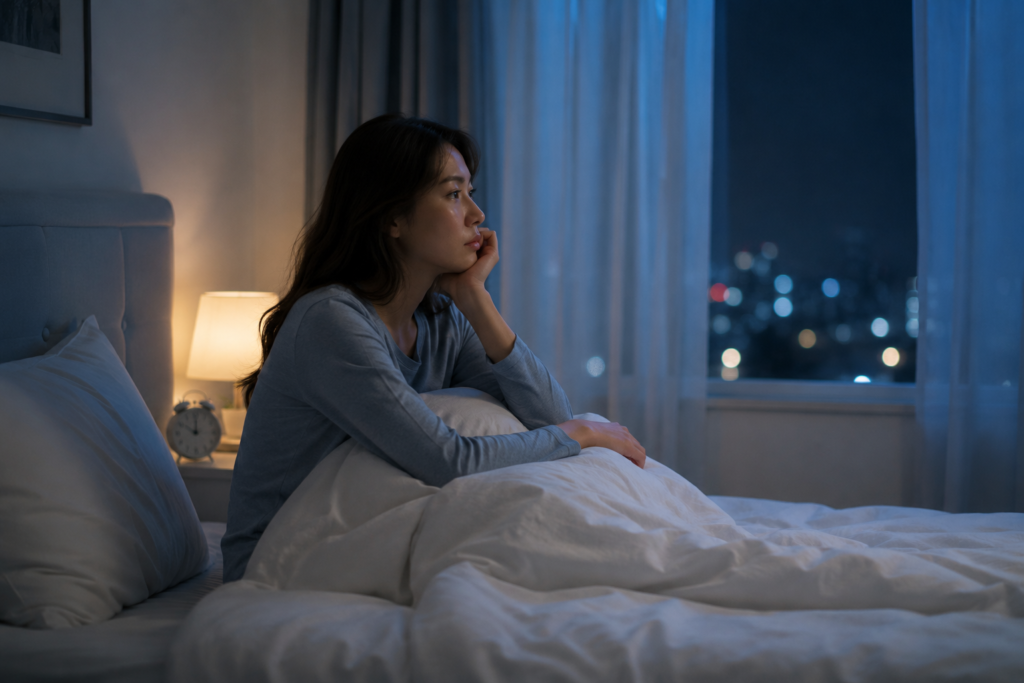
Some nights, you may fall asleep within minutes. On others, stress, caffeine, pain, an irregular schedule, or an active mind can keep you awake much longer. This variation is normal.
The problem begins when difficulty falling asleep becomes frequent, causes distress, or affects your mood, concentration, safety, and energy the following day.
This guide explains 12 practical strategies you can test, what to do when you are still awake in bed, and when ordinary sleep tips are no longer enough.
Quick answer: Keep a stable wake time, go to bed when you feel sleepy rather than simply tired, reduce evening stimulation, avoid late caffeine, make the bedroom comfortable, and leave the bed for a quiet activity if you become alert or frustrated. Test a small number of changes consistently instead of trying every sleep trick in one night.
How Long Should It Take to Fall Asleep?
The time between trying to sleep and actually falling asleep is called sleep-onset latency.
You may have heard that everyone should fall asleep within 10 to 20 minutes. That range is often used as a general reference, but it is not a pass-or-fail test for healthy sleep.
Sleep-onset time varies according to:
- Age
- Recent sleep loss
- Stress and emotional arousal
- Caffeine, nicotine, and alcohol
- Pain or physical discomfort
- Medication
- Menstrual or menopausal symptoms
- Work and travel schedules
- Noise, light, and temperature
- The time you got into bed
Falling asleep almost immediately every night can sometimes mean you are not getting enough sleep. Taking longer on an occasional stressful night does not automatically mean you have insomnia.
Pay more attention to the pattern than to one exact number.
Ask:
- Does this happen several nights each week?
- Has it continued for weeks or months?
- Do I feel distressed while trying to sleep?
- Am I tired, irritable, or unfocused during the day?
- Am I allowing enough time for sleep?
- Do I depend on alcohol, antihistamines, or supplements to fall asleep?
According to MedlinePlus, insomnia can involve trouble falling asleep, remaining asleep, or waking too early, together with poor-quality sleep or daytime consequences.
First, Identify What Is Keeping You Awake
Not every sleep-onset problem has the same cause.
| What you notice | Possible contributor | First adjustment to test |
|---|---|---|
| You are not sleepy at bedtime | Bedtime may be too early or your schedule may be irregular | Stabilize your wake time and wait for sleepiness |
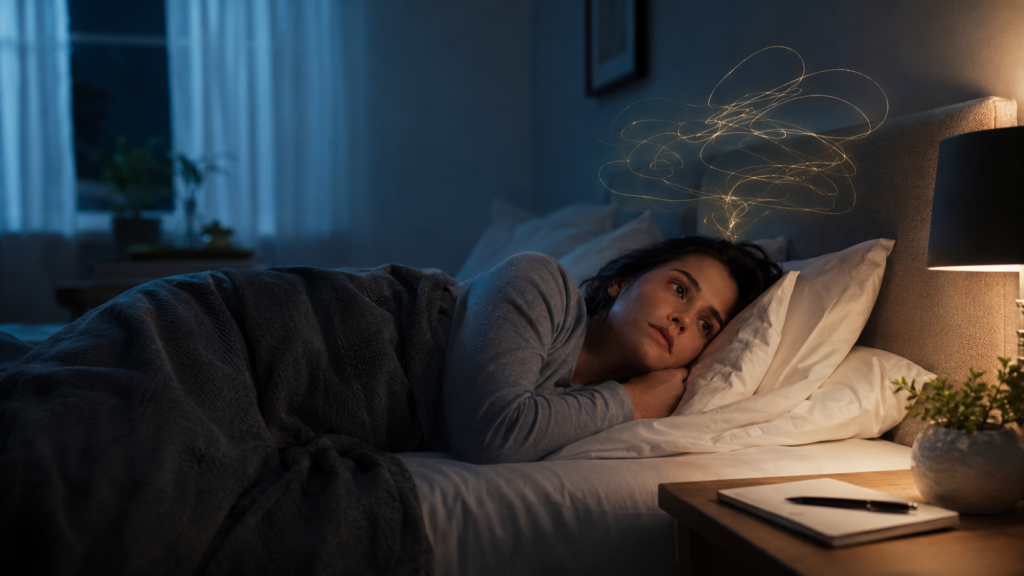
| Your thoughts accelerate in bed | Stress, worry, planning, or sleep anxiety | Use a written “brain dump” before bed |
| You feel sleepy until you open your phone | Bright light, stimulating content, notifications, or lost time | Move the phone away and choose a less engaging activity |
| You feel physically restless | Caffeine, nicotine, intense late activity, discomfort, or restless legs symptoms | Review substances, timing, and physical symptoms |
| You become hot or sweaty | Room temperature, bedding, hormones, medication, or illness | Adjust bedding and temperature |
| You fall asleep on the sofa but wake in bed | The bed may have become associated with effort and frustration | Go to bed only when sleepy and use stimulus control |
| You snore, gasp, or wake choking | Possible sleep-disordered breathing | Seek medical evaluation |
Trying to solve the wrong problem leads to increasingly complicated bedtime rituals. Start with the pattern you actually experience.
12 Science-Backed Ways to Fall Asleep Faster Naturally
1. Anchor Your Morning Wake Time
A consistent wake time is often more useful than forcing an exact bedtime.
Getting up at approximately the same time helps stabilize your sleep-wake rhythm and influences when sleepiness appears the following evening.
Try to:
- Wake at a similar time on workdays and days off.
- Avoid repeatedly turning off alarms and returning to sleep.
- Get out of bed once you are awake for the day.
- Expose yourself to ordinary daytime light after waking.
- Avoid sleeping several hours later after one poor night.
You do not need perfect seven-day precision. A realistic, repeatable schedule is more useful than a strict plan that lasts three days.
After a bad night, sleeping very late may provide temporary relief but can reduce sleep pressure the next evening. This sometimes creates a cycle of late sleep followed by another difficult bedtime.
2. Go to Bed When You Feel Sleepy
Feeling tired and feeling sleepy are not identical.
Tiredness may feel like low energy, stress, or mental exhaustion. Sleepiness includes heavier eyelids, yawning, reduced alertness, and difficulty keeping your eyes open.
Going to bed simply because the clock says it is bedtime can result in a long period of wakefulness if your body is not ready.
Instead:
- Begin your wind-down routine at a consistent time.
- Wait for clear signs of sleepiness before getting into bed.
- Avoid repeatedly testing whether you can sleep.
- Do not move bedtime dramatically earlier after one poor night.
This principle is part of stimulus control, one component of cognitive behavioral therapy for insomnia.
3. Build a Short, Repeatable Wind-Down Routine
A bedtime routine should reduce stimulation, not become a lengthy performance you are afraid to skip.
Choose two or three calm activities that fit into approximately 30 to 60 minutes:
- Prepare clothing or essential items for tomorrow.
- Dim unnecessarily bright lighting.
- Wash your face or take a comfortable shower.
- Read something calm.
- Listen to quiet audio.
- Perform gentle stretching.
- Write down unfinished tasks.
- Prepare the bedroom.
Use the same general sequence most nights. Repetition can help distinguish the end of the active day from the beginning of the sleep period.
For a complete example, read How to Build a Better Bedtime Routine.
4. Reduce Bright Light and Engaging Screen Use
The screen problem is not limited to blue light.
A phone may delay sleep because it also provides:
- Social interaction
- Work messages
- News
- Games
- Autoplaying videos
- Emotional stimulation
- Notifications
- An easy way to lose track of time
Light exposure at night can affect circadian timing, but content and behavior matter too. An older experimental study of evening light-emitting e-reader use found delayed circadian timing and reduced next-morning alertness, although real-world effects vary by device, brightness, duration, and the individual. Review the study through PubMed.
Try:
- Lowering screen brightness
- Using warmer display settings
- Avoiding work, arguments, and highly engaging videos
- Setting a stopping alarm
- Charging the phone outside arm’s reach
- Switching to audio or a printed book
- Keeping notifications out of the bedroom
There is no universal rule requiring every person to stop all screens exactly one hour before bed. Test whether reducing brightness, content, and duration improves your own sleep.
5. Move Caffeine Earlier
Caffeine does not leave the body as soon as its energizing effect becomes less noticeable.
Coffee is not the only source. Caffeine may also be found in:
- Energy drinks
- Tea
- Cola
- Chocolate
- Pre-workout products
- Some headache remedies
- Certain supplements
Sensitivity and metabolism vary considerably.
A controlled study found that a large 400 mg dose could disrupt sleep even when consumed six hours before bedtime. More recent research also suggests that both dose and timing matter; smaller amounts may have less effect than large doses. See the caffeine timing study.
A practical test is to:
- Record your caffeine sources and approximate timing.
- Move your final serving earlier by two hours.
- Keep the new cutoff for at least one week.
- Reduce the amount if timing alone does not help.
People who are pregnant, taking medication, or managing a medical condition should follow guidance appropriate to their health rather than using a generic caffeine limit.
6. Review Alcohol, Nicotine, Meals, and Fluids
Alcohol may create initial drowsiness, but it can lead to lighter, more disrupted sleep later. It may also worsen snoring, reflux, sweating, and nighttime urination.
Nicotine is stimulating and can make it harder to settle into sleep. Withdrawal during the night may also interrupt sleep.
Large or rich meals near bedtime can trigger:
- Fullness
- Reflux
- Abdominal discomfort
- Thirst
- Heat or sweating
Going to bed extremely hungry can be disruptive as well.
If hunger keeps you awake, choose a modest snack rather than treating one food as a natural sleeping pill. Read 8 Foods That Help You Sleep: What the Evidence Really Says.
Limit large amounts of fluid close to bedtime if bathroom trips interrupt your sleep, but do not deliberately dehydrate yourself.
7. Make the Bedroom Comfortable
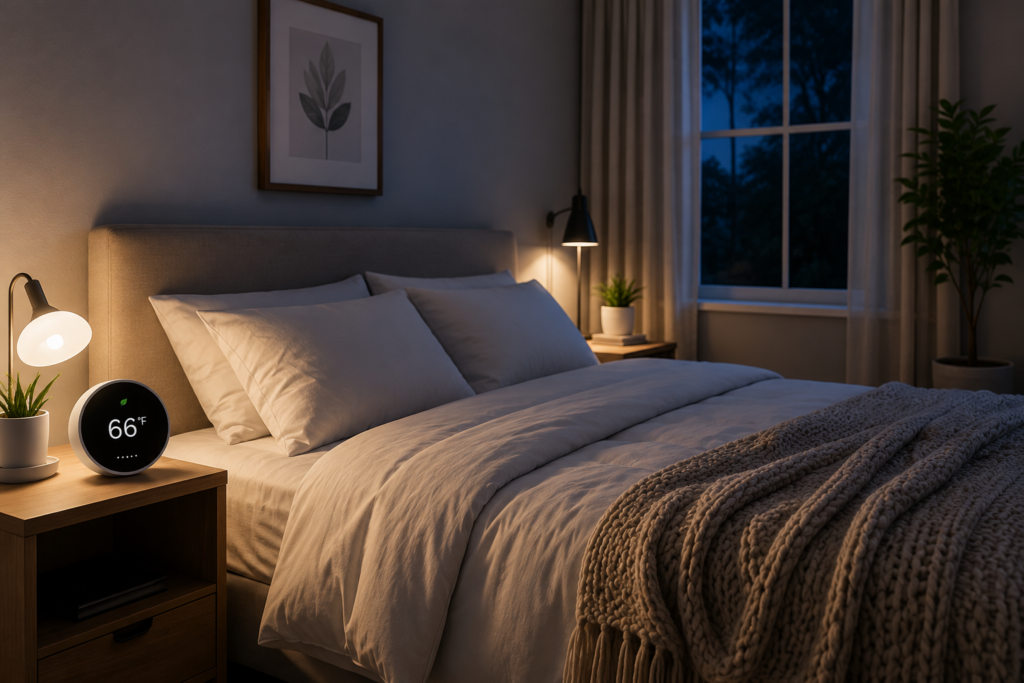
The bedroom should feel safe, dark enough, quiet enough, and thermally comfortable.
Useful adjustments may include:
- Blocking intrusive outdoor light
- Reducing unpredictable noise
- Silencing notifications
- Using bedding that does not trap excessive heat
- Supporting painful joints appropriately
- Keeping pets from repeatedly disrupting the bed
- Removing work materials when possible
- Making the clock less visible
A cool room helps many adults, but there is no perfect setting for everyone. Bedding, season, humidity, hormones, health, and personal preference all change how temperature feels.
Use Best Bedroom Temperature for Sleep to test your room and bedding together.
8. Get Daytime Light, Especially After Waking
Light is one of the strongest environmental signals affecting the circadian system.
Daytime light exposure helps your body distinguish day from night. Morning light can be particularly useful when your sleep schedule has gradually shifted later.
Try to:
- Open curtains after waking.
- Spend part of the morning outdoors when practical.
- Work near natural light during the day.
- Avoid remaining in a dim bedroom throughout the morning.
- Reduce unnecessarily bright light late at night.
The amount and timing needed vary by season, location, eye health, schedule, and circadian pattern.
Do not stare directly at the sun. People with eye conditions or medication-related light sensitivity should seek appropriate professional guidance.
9. Exercise Regularly, but Watch Your Own Timing
Regular physical activity can support overall health and sleep, but exercise should not be presented as a guaranteed treatment for insomnia.
Walking, cycling, swimming, resistance training, and other suitable activities may help build a healthier sleep-wake pattern.
Exercise timing is individual:
- Some people sleep well after evening activity.
- Others remain hot or alert after vigorous late exercise.
- Gentle movement may be calming.
- An intense workout used to compensate for a poor night can increase fatigue without resolving insomnia.
If late exercise appears to delay sleep, move the most intense activity earlier and observe the result for a week.
The 2025 VA/DoD insomnia guideline notes insufficient evidence to recommend exercise alone as a treatment for chronic insomnia. Evidence-based behavioral treatment remains more appropriate when insomnia persists. See the 2025 VA/DoD insomnia guideline.
10. Give Unfinished Thoughts Somewhere Else to Go
Trying to “clear your mind” can backfire because it turns relaxation into another task.
Instead, externalize thoughts before getting into bed.
Write down:
- Tomorrow’s essential tasks
- One issue you cannot solve tonight
- Anything you are afraid of forgetting
- The next small step for each concern
- The time tomorrow when you will revisit it
Keep the exercise brief. The goal is not to solve your life at 11:30 p.m. It is to reassure your brain that the information has been stored somewhere other than the ceiling.
Relaxation exercises may also help reduce arousal. Options include:
- Slow, comfortable breathing
- Progressive muscle relaxation
- Body scanning
- Guided imagery
- Grounding exercises
Avoid complicated breath-holding patterns if they make you dizzy, uncomfortable, or more focused on performance. Relaxation is a skill, not a knockout switch.
11. Turn the Clock Away
Clock watching encourages calculations such as:
- “I only have five hours left.”
- “Tomorrow is ruined.”
- “Why am I still awake?”
- “I must fall asleep now.”
These thoughts increase pressure at the exact moment when reduced effort would be more helpful.
Turn the clock away from the bed and avoid checking the phone repeatedly.
You can still use an alarm. You simply do not need a live scoreboard for insomnia. Sleep is one of the few activities that often becomes more elusive when aggressively supervised.
12. Leave the Bed When Wakefulness Becomes Frustrating
If you remain awake and begin feeling alert, irritated, or anxious, get out of bed and move to a safe, dimly lit place.
Do something quiet, such as:
- Reading calm material
- Listening to gentle audio
- Sitting comfortably
- Practicing a simple relaxation exercise
- Folding a few items without turning it into housework
Return to bed when sleepiness reappears. Repeat if necessary.
The commonly quoted “20-minute rule” is an approximation, not a reason to watch the clock. Use your sense that you have been awake long enough to become frustrated.
Do not drive, cook on a stove, drink alcohol, begin work, or use highly stimulating entertainment during this period.
Stimulus control is included in CBT-I because it helps rebuild the association between bed and sleep. The NHLBI insomnia treatment guide describes going to bed when sleepy, leaving the bed when unable to sleep, and reserving the bed for sleep and sexual activity.
A Simple Plan for Tonight
Trying all 12 recommendations at once creates another stressful bedtime project.
For tonight, use this shorter sequence:
Two to Three Hours Before Bed
- Finish large meals when practical.
- Avoid using alcohol as a sleep aid.
- Reduce unnecessary work and emotionally intense tasks.
- Check that the bedroom will be comfortable.
Thirty to Sixty Minutes Before Bed
- Dim excessively bright lighting.
- Put tomorrow’s tasks on paper.
- Reduce stimulating screen content.
- Choose one calm activity.
- Prepare only the bedding you need.
When You Feel Sleepy
- Go to bed.
- Turn the clock away.
- Allow sleep rather than testing for it.
- Use comfortable, unforced breathing.
If You Become Wide Awake or Frustrated
- Leave the bed.
- Sit somewhere safe under dim light.
- Do something quiet.
- Return when sleepiness comes back.
This plan will not guarantee immediate sleep. Its purpose is to remove avoidable obstacles and reduce the struggle surrounding bedtime.
Use a Two-Week Sleep Diary
A single night is influenced by too many variables to reveal a reliable pattern.
For two weeks, record:
- Time you got into bed
- Estimated time you tried to sleep
- Estimated time you fell asleep
- Nighttime awakenings
- Final wake time
- Time you got out of bed
- Naps
- Caffeine and alcohol timing
- Exercise
- Medication or supplements
- Major stress, pain, reflux, or illness
- Morning energy
Do not worry about recording exact minute-by-minute data. Estimates are sufficient.
Look for patterns such as:
- Sleep is worse after late caffeine.
- Bedtime is earlier than actual sleepiness.
- Weekend wake times shift dramatically.
- Long naps reduce evening sleepiness.
- Pain or reflux appears on difficult nights.
- Sleep worsens after alcohol.
- The bed has become a place for worrying.
Change one or two variables at a time. Otherwise, you will not know what helped.

Why Sleep Hygiene May Not Fix Chronic Insomnia
Healthy sleep habits are useful, but they are not the same as insomnia treatment.
Someone with chronic insomnia may already have:
- A dark bedroom
- An expensive mattress
- No afternoon coffee
- A consistent routine
- Several relaxation apps
- An impressive collection of herbal tea
Yet the person may still lie awake because the bed has become associated with effort, worry, monitoring, and failure.
The 2025 VA/DoD guideline recommends CBT-I for chronic insomnia and advises against relying on sleep-hygiene education as a standalone treatment. CBT-I and brief behavioral treatment address sleep-related behaviors and thoughts through a structured program.
CBT-I may include:
- Stimulus control
- Sleep scheduling
- Cognitive restructuring
- Relaxation strategies
- Sleep education
- Monitoring progress
Do not attempt aggressive sleep-restriction therapy on your own, particularly if you have bipolar disorder, epilepsy, untreated severe sleep apnea, parasomnias, high fall risk, or a job requiring constant alertness. Work with an appropriately trained healthcare professional.
What About Melatonin and Natural Sleep Supplements?
“Natural” does not necessarily mean harmless, effective, or suitable for nightly use.
Melatonin may be useful for certain circadian timing problems, including jet lag and delayed sleep-wake phase disorder. Evidence is not strong enough to recommend it as a routine treatment for chronic insomnia.
The NCCIH melatonin guide also notes:
- Long-term safety information is limited.
- Products may not contain the amount stated on the label.
- Melatonin can interact with medication.
- It can cause headache, dizziness, nausea, or sleepiness.
- Pregnant or breastfeeding people should seek medical guidance.
- Children should not be given melatonin without professional guidance.
Valerian, magnesium, antihistamine sleep aids, cannabis products, and other supplements should not automatically replace proper evaluation.
Talk with a healthcare professional or pharmacist before combining sleep products with prescription medication.
When to Seek Professional Help
Arrange an evaluation if difficulty falling asleep:
- Occurs at least several nights a week
- Persists for months
- Causes significant distress
- Affects work, school, relationships, memory, or mood
- Makes driving or operating equipment unsafe
- Continues despite adequate opportunity for sleep
- Began after a medication change
- Occurs with depression, anxiety, trauma, or mood changes
- Requires frequent alcohol, antihistamines, or supplements
Seek medical attention for symptoms such as:
- Loud snoring with gasping or breathing pauses
- Falling asleep while driving
- Severe daytime sleepiness
- An uncontrollable urge to move the legs
- Chest pain or breathing difficulty
- Severe pain or reflux
- Unexplained night sweats, fever, or weight loss
- Unusual nighttime behaviors
- Symptoms of mania, including little need for sleep with unusually high energy
- Thoughts of self-harm
If falling asleep is not the main problem and you repeatedly wake later, read Why You Wake Up at Night: 10 Causes and What to Do.
Frequently Asked Questions
What is the fastest natural way to fall asleep?
There is no technique that reliably makes everyone fall asleep immediately. The most useful starting combination is a consistent wake time, going to bed when sleepy, reducing evening stimulation, and leaving the bed when wakefulness becomes frustrating.
Is it normal to take 30 minutes to fall asleep?
It can happen occasionally, especially during stress, travel, illness, or schedule changes. It becomes more concerning when it happens frequently, causes distress, or affects daytime functioning.
Should I stay in bed and rest if I cannot sleep?
Quiet rest may feel comfortable for a short period. However, if you become alert, frustrated, or anxious, briefly leaving the bed for a calm activity can help prevent the bed from becoming associated with struggle.
Does the 4-7-8 breathing method make you fall asleep?
Some people find paced breathing calming, but one specific counting pattern is not proven to work for everyone. Use slow, comfortable breathing without forcing long breath holds.
Can I train myself to fall asleep in two minutes?
Claims that everyone can learn to fall asleep in exactly two minutes are not supported as a dependable medical standard. Trying to meet a strict deadline may increase sleep pressure and anxiety.
Should I take melatonin every night?
Do not assume nightly melatonin is necessary or risk-free. Its usefulness depends on the cause and timing of the sleep problem. Discuss regular use with a healthcare professional, particularly if you take medication or have a medical condition.
Why am I exhausted but not sleepy at bedtime?
Stress, circadian timing, late caffeine, long naps, screen use, pain, medication, and conditioned arousal can produce this pattern. A two-week sleep diary can help identify the most likely contributor.
How long should I test these sleep habits?
Test a small number of changes consistently for approximately two weeks. If significant insomnia continues, consider professional evaluation and CBT-I rather than adding more bedtime rituals.
Final Thoughts
Learning how to fall asleep faster naturally does not require winning a nightly battle against your own brain.
Begin with the factors that have the strongest practical value:
- Keep your wake time reasonably stable.
- Wait for genuine sleepiness before getting into bed.
- Move caffeine earlier.
- Reduce bright, engaging evening activities.
- Make the bedroom comfortable.
- Stop monitoring the clock.
- Leave the bed when wakefulness becomes frustrating.
Track the results for two weeks instead of judging every night separately.
If the problem is persistent, healthy sleep habits alone may not be enough. CBT-I is a structured, evidence-based treatment that addresses the behaviors and thoughts maintaining chronic insomnia.
The goal is not to force sleep faster. It is to make bedtime a reliable opportunity for sleep again.