White Noise Benefits for Sleep: Does It Really Help You Sleep Better?
White noise benefits for sleep are most likely to appear when unpredictable environmental sounds—not insomnia itself—are keeping you awake.
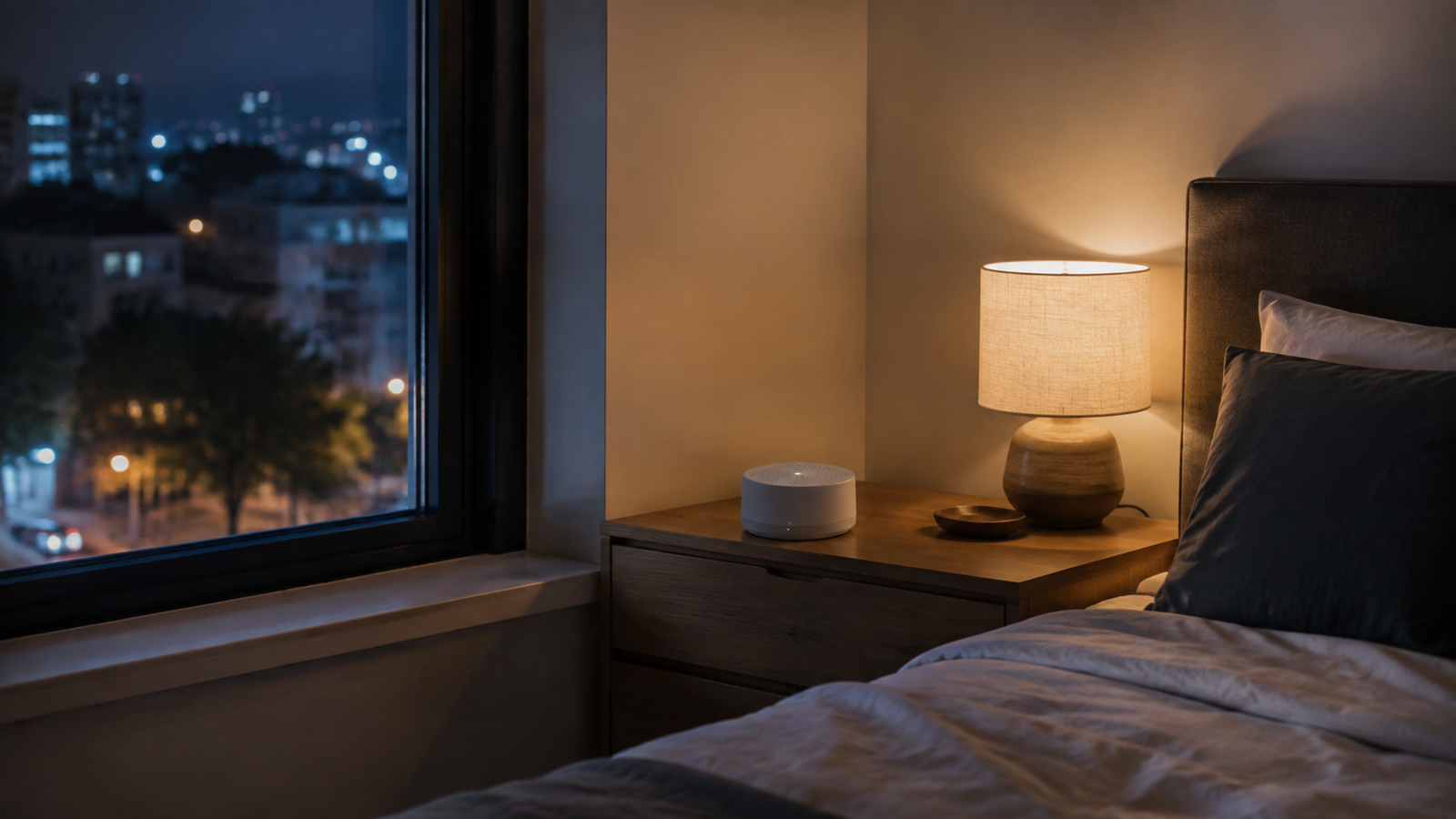
A barking dog, a closing car door, an apartment hallway, or early-morning traffic can seem especially noticeable when the bedroom is otherwise quiet. White noise adds a steady background sound that reduces the contrast between those interruptions and the rest of the room.
That masking effect may help some people fall asleep or wake less often. However, adding sound is not automatically better than sleeping in a quiet room, and research does not show that white noise works for everyone.
Quick answer: White noise may be worth testing if changing sounds repeatedly disturb your sleep. Use the lowest effective volume, place the speaker away from your head, keep important alarms audible, and compare several nights with and without it. It should be treated as an optional sound-masking tool, not a cure for insomnia.
What Is White Noise?
Technically, white noise is a signal containing equal power across equal frequency bands. To most listeners, it sounds like a steady hiss similar to radio static.
The term is often used more loosely for continuous background sounds such as:
- A fan
- An air purifier
- Air conditioning
- Steady rainfall
- Ventilation
- A sound-machine recording
These sounds are not necessarily true white noise. A fan, for example, produces a combination of airflow and mechanical frequencies rather than a mathematically flat sound spectrum.
This distinction matters because many products marketed as “white noise machines” actually offer several types of broadband noise, nature recordings, and fan sounds.
The label is less important than three practical questions:
- Does the sound reduce the specific noise disturbing you?
- Can you play it at a low, comfortable level?
- Do you sleep better with it than without it?
How Does White Noise Mask Nighttime Sounds?
White noise does not remove traffic, voices, or other sounds. It raises the bedroom’s background sound level so that sudden changes become less noticeable.
Imagine a quiet room with a background level of 25 decibels. A passing vehicle produces a sharp contrast against that silence. Adding a low, steady sound may make the vehicle less prominent, even though the vehicle itself has not become quieter.
This is called sound masking.
Masking may be useful for:
- Doors opening and closing
- Intermittent traffic
- Distant conversations
- A television in another room
- Household members waking earlier
- Hotel corridor activity
- Moderate neighborhood noise
It is usually less effective against:
- Very loud music
- Heavy bass passing through walls
- Construction immediately outside
- Persistent mechanical vibration
- Snoring or gasping requiring medical attention
- Sounds that must remain audible for safety
White noise also adds sound to the room. If your bedroom is already quiet and you sleep well, introducing another noise may offer no benefit and could become distracting.
What Does Research Say About White Noise Benefits for Sleep?
The evidence is more complicated than many product advertisements suggest.
A 2021 systematic review of noise used as a sleep aid concluded that better studies using objective sleep measurements and clearly reported sound exposure were needed before continuous noise could be broadly promoted for sleep.
A 2022 systematic review of auditory stimulation found positive results in some white- and pink-noise studies, but the studies differed substantially in sound type, duration, participant group, and outcome measurement.
More recently, a 2025 systematic review and meta-analysis combined 12 randomized trials involving 1,301 participants. It reported improved questionnaire-based sleep-quality scores among adults and older adults.
That sounds encouraging, but several limitations matter:
- Many participants were hospital patients.
- Results differed across age groups and settings.
- The adult sleep-quality results showed substantial heterogeneity.
- Some subgroups contained only a small number of studies.
- Sound types, volumes, durations, and measurement methods varied.
- Improvements in subjective sleep scores do not prove that every stage of sleep improved.
The fairest conclusion is that white noise shows potential in certain noisy or clinical environments, but it is not an established treatment for every sleep problem.
Five Realistic White Noise Benefits for Sleep
1. It May Mask Unpredictable Noise
This is the strongest practical reason to try white noise.
The brain is more likely to notice a sudden change than a stable background. A steady sound may make intermittent traffic, doors, voices, and household activity less prominent.
White noise is unlikely to make an extremely loud bedroom healthy or comfortable. Reduce the unwanted sound itself whenever possible before adding another sound.
Options include:
- Closing windows
- Sealing gaps around doors
- Moving the bed away from a shared wall
- Using curtains or soft furnishings
- Asking household members to lower nighttime volume
- Repairing rattling vents or appliances
- Addressing building or neighborhood noise through appropriate channels
White noise should complement practical noise reduction, not replace it.
2. It May Make Sleep Onset Easier in Noisy Settings
If every passing vehicle captures your attention, a steady sound may help the room feel less changeable.
This may be useful for:
- Apartment residents
- Urban sleepers
- Travelers
- Shift workers sleeping during the day
- People sharing a home with different schedules
The benefit probably comes primarily from reducing acoustic contrast. White noise should not be described as a sedative that directly switches off the brain.
If worry, pain, caffeine, circadian timing, or conditioned insomnia is keeping you awake, sound masking alone may do very little.
For broader sleep-onset strategies, read How to Fall Asleep Faster Naturally.
3. It May Reduce Some Noise-Related Awakenings
People can experience brief awakenings after a sound changes, even when they do not remember every interruption the next morning.
A continuous sound may reduce the prominence of moderate nighttime disturbances. Whether this produces a meaningful improvement depends on:
- How loud the unwanted sound is
- How often it occurs
- The frequency range of the sound
- The white-noise volume
- The sleeper’s sound sensitivity
- Whether the masking sound is comfortable
- The cause of the awakenings
White noise will not prevent awakenings caused by hot flashes, pain, reflux, sleep apnea, medication, alcohol, or frequent urination.
If waking later in the night is the main concern, review Why You Wake Up at Night: 10 Causes and What to Do.
4. It Can Create a Familiar Travel Environment
A portable sound may make an unfamiliar hotel, rental property, or relative’s home feel more predictable.
Familiarity can be useful when the new environment contains elevators, hallway conversations, plumbing, or unfamiliar traffic.
You do not necessarily need a separate machine. A fan or a carefully selected recording may provide a similar masking effect.
If using a phone:
- Download the recording before traveling.
- Disable notifications and calls when appropriate.
- Keep the screen off.
- Check for sudden advertisements.
- Make sure the audio does not contain noticeable loops.
- Leave emergency alerts enabled as needed.
5. It Offers a Non-Drug Option for Environmental Noise
White noise does not involve sedating medication, alcohol, or an ingestible supplement.
That does not make it completely risk-free, but it can be a relatively simple environmental experiment when sound is the identifiable problem.
If it does not help after a reasonable trial, there is no need to keep increasing the volume or buying increasingly complicated devices. Sometimes silence wins. Silence is annoyingly affordable like that.
Who Is Most Likely to Benefit?
White noise may be worth testing when:
| Sleep situation | Is white noise worth testing? | Why |
|---|---|---|
| Intermittent traffic or hallway noise | Yes | A steady sound may reduce sudden contrast |
| Different household schedules | Possibly | It may mask moderate movement and voices |
| Unfamiliar hotel noise | Possibly | It can provide a consistent background |
| Daytime sleep for shift work | Possibly | It may reduce moderate household activity |
| Quiet room with stress-related insomnia | Less likely | Environmental sound is not the main cause |
| Loud bass or structural vibration | Usually not enough | These sounds are difficult to mask safely |
| Snoring, gasping, or choking | No | Medical assessment may be needed |
| Bedroom is already quiet and comfortable | Usually unnecessary | Adding noise may offer no advantage |
The goal is not to identify yourself as a “light sleeper.” It is to determine whether changing environmental sound is actually contributing to your problem.
White Noise vs. Pink Noise vs. Brown Noise
The colors describe how sound energy is distributed across frequencies. They are not different medications with proven, separate health benefits.
White Noise
White noise contains equal power per frequency interval. It has a noticeable high-frequency hiss and may sound similar to static.
It may mask voices and higher-pitched environmental sounds effectively, but some listeners find it sharp.
Pink Noise
Pink noise contains less energy at higher frequencies relative to white noise. It often sounds softer and more balanced.
Rainfall and ocean recordings are frequently described as pink noise, although real nature recordings do not always match a precise mathematical spectrum.
Some studies have investigated pink noise and sleep, but there is not enough consistent evidence to call it universally better than white noise.
Brown Noise
Brown noise emphasizes lower frequencies more heavily and produces a deeper rumbling sound.
It may feel warmer or less hiss-like, but research specifically supporting brown noise as a sleep treatment remains very limited.
Fan and Nature Sounds
Fans, rain, wind, and waves are not automatically white, pink, or brown noise. Their sound patterns may also contain variation.
They can still be useful if they are:
- Comfortable
- Predictable
- Free from startling changes
- Low enough in volume
- Effective against the disturbance in your room
Choose based on your actual sleep response rather than the popularity of a noise color.
How to Use White Noise Safely
Start With the Lowest Effective Volume
White noise needs to reduce the prominence of unwanted sound—not overpower everything in the room.
Begin with the lowest setting. Increase it only until the distracting sound becomes less noticeable.
The National Institute on Deafness and Other Communication Disorders states that sounds at or below 70 dBA are generally unlikely to cause hearing loss, while long or repeated exposure at or above 85 dBA can cause damage.
These numbers are hearing-risk references, not recommended targets for sleep machines. Your sleeping volume should normally be far below a level that requires you to raise your voice.
No universal decibel setting is ideal for every adult bedroom. Device output, distance, room acoustics, and individual hearing all matter.
A phone sound-meter application may provide a rough check at pillow level, but it is not equivalent to a professionally calibrated meter.
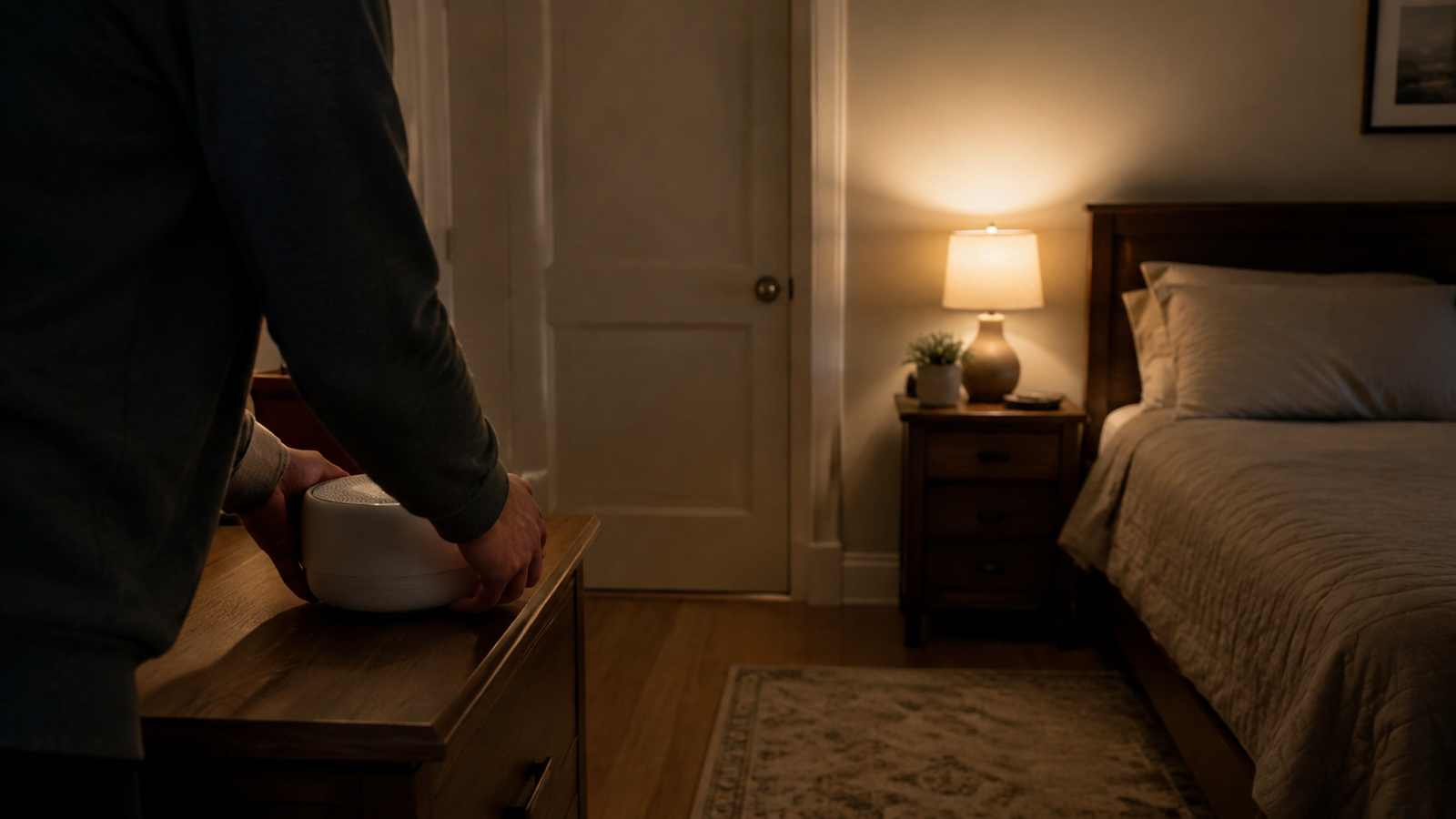
Place the Device Away From Your Head
Do not position a speaker directly beside your ear or underneath your pillow.
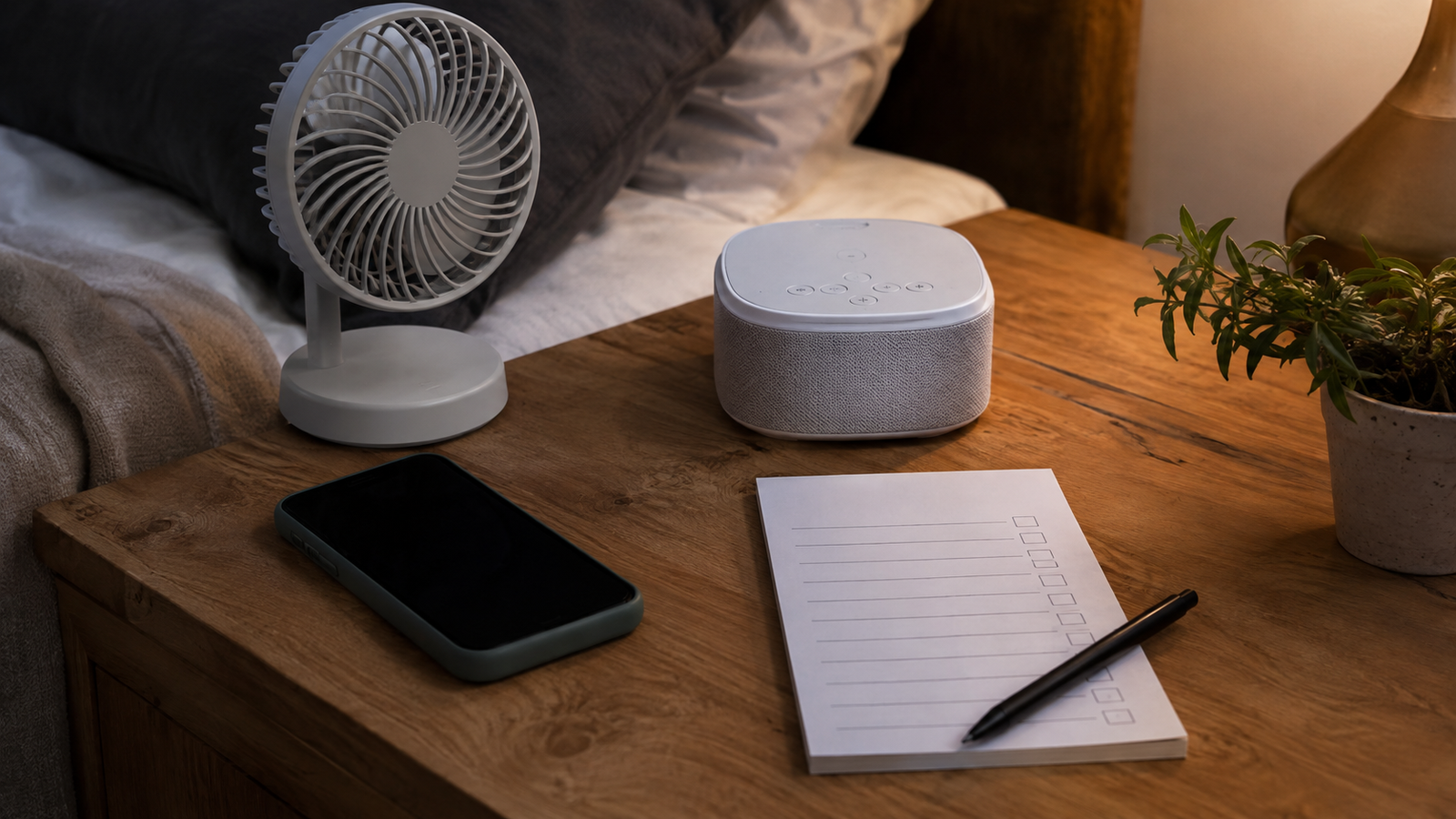
Place it on a stable surface several feet from the bed when possible. If you are masking a window, hallway, or shared wall, testing a position between that area and the bed may help.
Room acoustics vary, so compare locations rather than assuming the nearest position will work best.
Keep the device:
- Away from bedding
- Away from liquids
- On a stable surface
- Free from damaged cables
- Clear of ventilation openings
- Out of walking paths
Avoid Sleeping in Earbuds or Headphones
Playing continuous noise through earbuds produces sound much closer to the ear than a speaker across the room.
Overnight earbuds or headphones may also cause:
- Ear-canal irritation
- Pressure discomfort
- Moisture buildup
- Difficulty hearing alarms
- Cord or battery-related concerns
- Higher-than-intended sound exposure
A room speaker or dedicated sound machine is generally more appropriate for continuous overnight masking.
People with tinnitus, hearing loss, sound sensitivity, ear pain, or recent ear surgery should seek individualized advice rather than using louder sound to cover symptoms.
Keep Important Sounds Audible
Do not set the machine so loudly that it masks:
- Smoke alarms
- Carbon-monoxide alarms
- Security alarms
- A child calling
- Medical-device alerts
- Emergency phone notifications
Sound masking should make ordinary disturbances less noticeable without disconnecting you from essential safety signals.
Use a Timer When All-Night Sound Is Unnecessary
If the disturbance mainly affects sleep onset, try a timer that turns the sound off after you are likely to be asleep.
If traffic or household noise continues throughout the night, continuous playback may be more useful. However, research has not established that every adult benefits from uninterrupted white noise all night.
Compare:
- Sound only while falling asleep
- Sound throughout the night
- No added sound
Use whichever option produces better sleep at the lowest practical exposure.
Choose a Smooth, Predictable Recording
Avoid recordings with:
- Sudden volume changes
- Short, noticeable loops
- Voices
- Musical transitions
- Thunderclaps
- Bird calls
- Advertisements
- Automatic playback changes
Once the brain notices a repeated loop, waiting for the next repetition can become strangely entertaining—the exact opposite of the assignment.
Try This Seven-Night White Noise Test
A single good or bad night proves very little. Stress, caffeine, exercise, alcohol, temperature, and bedtime all affect sleep.
Use this simple test to decide whether white noise is useful in your room.
| Nights | Condition |
|---|---|
| 1–2 | Sleep without added sound |
| 3–4 | Test low-volume white noise |
| 5–6 | Test a softer alternative such as fan or pink noise |
| 7 | Repeat the condition that seemed most helpful |
Each morning, record:
- Approximate time needed to fall asleep
- Number of remembered awakenings
- The main sound disturbances
- Morning restfulness from 1 to 5
- Whether the masking sound felt calming or irritating
- Whether the volume seemed too high
- Caffeine and alcohol timing
- Unusual stress, pain, illness, or temperature
Keep your wake time and other major sleep habits reasonably consistent during the test.
This is not a medical experiment, and the results will not diagnose a sleep disorder. It simply helps you avoid judging a product from one unusually good night.
Can You Become Dependent on White Noise?
White noise is not considered addictive in the medical sense.
However, any repeated sleep cue can become familiar. Some people may feel that a bedroom seems unusually empty or distracting when the sound is unavailable.
That does not necessarily mean dependence. It may simply reflect:
- Preference
- Habit
- A learned bedtime association
- The return of environmental noise that had been masked
If you want to stop using it:
- Reduce the volume gradually.
- Use a shorter timer.
- Alternate quiet and sound nights.
- Continue addressing the original noise source.
- Keep a portable option available for travel if needed.
There is no requirement to discontinue a low-volume sound that is comfortable and genuinely useful. There is also no benefit in forcing yourself to use it because someone online declared brown noise the new bedtime wizard.
What White Noise Cannot Treat
White noise may improve the sound environment, but it cannot diagnose or treat:
- Chronic insomnia
- Obstructive sleep apnea
- Restless legs syndrome
- Circadian rhythm disorders
- Depression or anxiety
- Chronic pain
- Reflux
- Medication side effects
- Menopausal night sweats
- Hearing disorders
Healthy bedroom conditions still matter. Temperature, light, bedding, and nighttime habits can be as important as sound.
For a practical temperature check, read Best Bedroom Temperature for Sleep.
When to Seek Professional Help
Speak with a healthcare professional if sleep problems:
- Continue for several weeks or months
- Occur several nights each week
- Affect work, school, relationships, mood, or memory
- Cause unsafe daytime sleepiness
- Persist even in a quiet environment
- Require increasingly loud masking sound
- Begin after a medication change
Arrange an evaluation if you experience:
- Loud snoring
- Gasping or choking during sleep
- Witnessed breathing pauses
- Morning headaches
- Severe daytime sleepiness
- Falling asleep while driving
- An uncontrollable urge to move your legs
- Ear pain, hearing changes, or worsening tinnitus
- Unusual nighttime behaviors
White noise can make a room sound more consistent. It cannot make an untreated sleep disorder disappear.
Frequently Asked Questions
Does white noise really help you sleep?
It may help when intermittent environmental noise is disturbing sleep. Research has reported benefits in some groups, but study methods and results vary. It does not reliably improve sleep for everyone.
Is it better to sleep in silence or with white noise?
If your bedroom is quiet and you already sleep well, silence is usually sufficient. White noise is most useful when unpredictable sounds cannot be fully eliminated.
What volume should white noise be for sleeping?
Use the lowest volume that adequately reduces distracting sounds. Do not treat 70 or 85 dBA hearing-risk thresholds as target sleep-machine settings. The sound should remain comfortably in the background.
Can I leave a white noise machine on all night?
Some adults use low-volume sound throughout the night when unwanted noise continues. Others need it only while falling asleep. Test both approaches and avoid louder or closer exposure than necessary.
Where should I place a white noise machine?
Place it on a stable surface away from your head and bedding. Testing a position between the bed and the main noise source may improve masking, although room acoustics differ.
Is a fan considered white noise?
Not technically. A fan produces a steady mixture of airflow and mechanical sound, but it can provide a similar masking function.
Is pink or brown noise better than white noise?
There is no universally superior noise color for sleep. Pink or brown noise may feel softer, while white noise may mask some higher-frequency sounds more effectively. Comfort and actual results matter more than the label.
Can white noise cure insomnia?
No. It may help when environmental sound contributes to poor sleep, but chronic insomnia often requires structured treatment such as cognitive behavioral therapy for insomnia.
Should babies use the same settings as adults?
No. Infants and children require separate, more conservative guidance because their distance from the device, exposure duration, and developmental risks differ. Adult volume advice should not be applied automatically to a nursery.
Final Thoughts
The clearest white noise benefit for sleep is sound masking.
It may help when traffic, doors, voices, hotel activity, or different household schedules create sudden changes in the bedroom’s sound environment. The scientific evidence is encouraging in some settings but still too inconsistent to describe white noise as a universal sleep treatment.
Start by reducing avoidable noise. If interruptions remain:
- Test white noise at a low volume.
- Place the device away from your head.
- Keep alarms audible.
- Avoid overnight earbuds.
- Compare it with silence and softer sounds.
- Record the results for seven nights.
- Stop if it feels irritating or requires excessive volume.
The best sleep sound is not necessarily white, pink, brown, expensive, or trending. It is the quietest option that makes your actual bedroom easier to sleep in.