Why Does Anxiety Get Worse at Night? 8 Possible Reasons
The room is quiet, the day is finally over, and you are ready to rest. Yet instead of feeling calm, your mind begins reviewing tomorrow’s responsibilities, past conversations, health concerns, financial worries, and every unlikely problem it can find.
If this happens regularly, you may wonder, why does anxiety get worse at night?
Anxiety may feel more intense at night because distractions disappear, fatigue reduces your ability to manage stress, and the pressure to fall asleep makes every thought and physical sensation feel more important. Caffeine, screen content, irregular sleep habits, and fear of another sleepless night may add to the problem.
Nighttime anxiety does not always indicate an anxiety disorder. However, frequent or overwhelming symptoms deserve attention—especially when they interfere with sleep, daytime functioning, or your sense of safety.
The Short Answer
Anxiety can feel worse at night for several possible reasons:
- Daytime distractions disappear.
- Unprocessed stress surfaces.
- Mental fatigue weakens emotional control.
- Bedtime creates pressure to fall asleep.
- Physical sensations become more noticeable.
- Caffeine and stimulating content maintain alertness.
- Previous sleepless nights create anticipatory anxiety.
- An inconsistent schedule disrupts the sleep-wake rhythm.
Several of these factors may occur together. For example, you might enter bed mentally exhausted, notice your heartbeat, worry that you will not sleep, and then become even more alert.
The goal is not to eliminate every anxious thought. It is to understand what is activating your mind and nervous system so you can respond more effectively.
What Does Nighttime Anxiety Feel Like?
Nighttime anxiety can involve thoughts, emotions, physical sensations, and sleep-related behaviors.
Mental Symptoms
You may experience:
- Racing thoughts
- Replaying conversations
- Imagining worst-case scenarios
- Worrying about tomorrow
- Difficulty making decisions
- Fear that something is wrong
- Repeatedly calculating how much sleep remains
- Feeling unable to “switch off” your brain
Physical Symptoms
Anxiety may also produce:
- A fast or noticeable heartbeat
- Muscle tension
- A tight jaw
- Restlessness
- Sweating
- Shallow or rapid breathing
- Stomach discomfort
- A feeling of pressure in the chest
- Trembling or tingling sensations
Anxiety can cause genuine physical symptoms, but new, severe, or unexplained symptoms should not automatically be attributed to anxiety.
Seek urgent medical care for severe chest pain, fainting, significant difficulty breathing, sudden weakness, confusion, or symptoms that may indicate a medical emergency.
Behavioral Signs
Nighttime anxiety may change what you do before or during sleep.
Common patterns include:
- Avoiding bedtime
- Staying online until exhaustion
- Checking the clock repeatedly
- Searching symptoms on your phone
- Asking others for repeated reassurance
- Remaining in bed while increasingly frustrated
- Using alcohol to feel sleepy
- Taking medication differently than directed
- Canceling morning plans because you expect poor sleep
These behaviors may bring temporary relief while reinforcing the idea that nighttime wakefulness is dangerous or unmanageable.
Is It Normal to Feel More Anxious at Night?
Occasional nighttime anxiety is common, particularly before:
- An important appointment
- A difficult conversation
- Travel
- A medical test
- A work deadline
- A major life change
- A financial decision
- A family event
A temporary increase in worry does not necessarily mean you have an anxiety disorder.
According to the National Institute of Mental Health, anxiety disorders involve more than occasional fear or worry. Symptoms may persist, occur in many situations, worsen over time, and interfere with daily life.
Professional guidance may be appropriate when anxiety:
- Occurs most nights
- Feels difficult to control
- Causes frequent sleep loss
- Continues for several weeks
- Produces panic attacks
- Affects work or relationships
- Leads to avoidance or substance use
- Occurs with persistent sadness or hopelessness
Why Does Anxiety Get Worse at Night?
Anxiety does not necessarily become biologically stronger for everyone after sunset. In many cases, it simply becomes more noticeable because the conditions surrounding bedtime amplify it.
Here are eight possible reasons.
1. Daytime Distractions Disappear
During the day, your attention moves between work, family responsibilities, errands, conversations, traffic, messages, and household tasks.
These activities do not remove anxiety, but they compete for your attention.
When the environment becomes quiet, concerns that remained in the background may move to the foreground. Without another task demanding attention, your brain may begin reviewing:
- What went wrong today
- What you forgot to complete
- What could happen tomorrow
- What someone meant during a conversation
- Whether you made the correct decision
- What might happen if you cannot sleep
The problem is not necessarily that the thoughts become more important at night. They simply have a quieter stage and, unfortunately, your brain has booked the entire performance.
This is especially likely when you suppress worries during the day without giving yourself time to process or address them.
2. Unprocessed Stress Surfaces at Bedtime
A busy schedule can delay emotional processing.
You may spend the day responding to immediate demands without pausing to acknowledge disappointment, anger, uncertainty, grief, or fear. When activity stops, those emotions may finally become noticeable.
Unprocessed stress might appear as:
- Replaying an upsetting interaction
- Mentally rehearsing a future conversation
- Creating imaginary solutions to uncontrollable problems
- Feeling responsible for everything that remains unfinished
- Remembering concerns you avoided earlier
- Experiencing vague dread without identifying a specific cause
Your mind may be attempting to protect you by reviewing threats and searching for solutions. The difficulty is that most problems cannot be solved effectively from bed.
If this pattern is frequent, a short planning or reflection period earlier in the evening can give concerns a more appropriate place to be acknowledged.
Understanding how stress affects sleep can help you recognize why unresolved tension often becomes more noticeable at bedtime.
3. Mental Fatigue Makes Worries Harder to Manage
By nighttime, you may have spent hours making decisions, controlling emotions, solving problems, caring for others, and completing responsibilities.
This mental fatigue can make it harder to:
- Evaluate a worry realistically
- Redirect your attention
- Tolerate uncertainty
- Remember that a problem can wait
- Separate possibility from probability
- Respond to yourself with patience
A concern that feels manageable at 10 a.m. may seem overwhelming at midnight because you are tired and have fewer mental resources available.
Fatigue can also encourage black-and-white thinking:
- “If I do not sleep soon, tomorrow will be a disaster.”
- “If I made one mistake, I probably ruined everything.”
- “If I feel anxious now, I will feel this way all night.”
- “If I cannot solve this immediately, something bad will happen.”
Nighttime is rarely the best time to make major decisions or reach conclusions about your health, relationships, work, or future. Recording the concern and returning to it after sleep is often more productive.
4. The Pressure to Sleep Creates More Anxiety
Sleep usually develops when the body is ready and the mind is not closely monitoring the process.
However, after several difficult nights, bedtime may begin to feel like a test.
You may think:
- “I have to sleep tonight.”
- “Why am I not sleepy yet?”
- “I cannot handle another bad night.”
- “What if I am still awake in two hours?”
- “I need eight full hours or tomorrow is ruined.”
This pressure increases alertness—the opposite of what sleep requires.
You might then monitor:
- Your breathing
- Your heartbeat
- The position of your body
- Every sound in the room
- Whether your eyelids feel heavy
- How many minutes have passed
- Whether a relaxation technique is working
The more closely you check for sleep, the more aware you become of being awake.
This can create a repeating cycle:
- You worry about falling asleep.
- Your body becomes more alert.
- You notice that you are still awake.
- You predict a difficult day tomorrow.
- The prediction produces more anxiety.
- Sleep becomes even less likely.
This pattern is sometimes described as sleep anxiety or conditioned arousal. Breaking it involves reducing the struggle around wakefulness rather than trying harder to force sleep.
If racing thoughts are keeping you awake, these practical strategies can help you stop overthinking at night
5. Physical Sensations Become More Noticeable
During the day, movement, conversation, background noise, and other activities compete for your attention. At night, the quiet environment can make ordinary physical sensations feel unusually noticeable.
You may suddenly focus on:
- Your heartbeat
- The rhythm of your breathing
- Muscle tension
- Stomach discomfort
- Tingling sensations
- Changes in body temperature
- Minor aches or pains
- The feeling of pressure in your chest
Anxiety can then create a feedback loop:
- You notice a physical sensation.
- You interpret it as a sign that something may be wrong.
- The interpretation increases anxiety.
- Anxiety intensifies the physical sensation.
- You monitor your body even more closely.
For example, noticing your heartbeat may cause concern, which can make your heart beat faster. The faster heartbeat may then seem like confirmation that there is a serious problem.
Try labeling the experience without immediately reaching a conclusion:
“I am noticing a strong heartbeat, and anxiety may be making me focus on it.”
Then gently redirect your attention toward a neutral sound, relaxed breathing, or the sensation of the mattress supporting your body.
However, do not assume every symptom is caused by anxiety. Seek medical advice for new, persistent, worsening, or concerning symptoms. Severe chest pain, fainting, sudden weakness, or significant difficulty breathing requires urgent medical attention.
6. Caffeine and Stimulating Content Maintain Alertness
Anxiety may feel purely psychological, but evening habits can keep both the brain and body in a more alert state.
Late Caffeine
Caffeine blocks adenosine, a chemical involved in building sleep pressure. Its effects can remain for several hours, although sensitivity varies considerably between individuals.
Common caffeine sources include:
- Coffee
- Espresso
- Energy drinks
- Black tea
- Green tea
- Cola
- Pre-workout supplements
- Some headache medications
- Chocolate
Caffeine may contribute to:
- Restlessness
- A noticeable heartbeat
- Shakiness
- Difficulty relaxing
- Racing thoughts
- Delayed sleepiness
- More frequent nighttime awakenings
These sensations can resemble or intensify anxiety.
If you regularly feel anxious at night, try moving your final caffeinated drink earlier. Some people may need to stop six or more hours before bedtime, while highly sensitive individuals may benefit from an even earlier cutoff.
Understanding how blue light affects sleep may help you reduce stimulating screen exposure before bedtime.
Emotionally Stimulating Content
Screen use is not only about blue light. The content itself may keep your nervous system activated.
Examples include:
- Work emails
- Financial news
- Online arguments
- Disturbing videos
- Health-related searches
- Competitive games
- Crime programs
- Short-form video feeds
- Social media comparisons
Checking one symptom before bed can quickly become an hour of reading rare medical conditions. The internet is impressively efficient at turning a mild concern into a small internal documentary series.
During the final 30 to 60 minutes before bed, choose familiar and emotionally neutral activities. Silence unnecessary notifications, lower the lighting, and place your phone beyond easy reach if nighttime searching is a recurring problem.
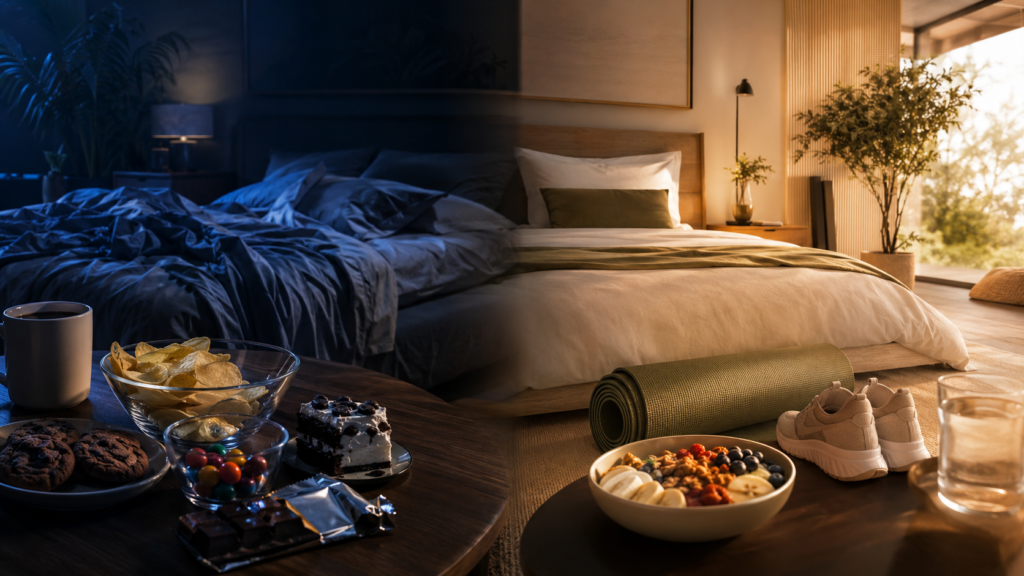
Reducing caffeine and electronic device use may help lower mental and physical alertness before bed.
7. Previous Sleepless Nights Create Anticipatory Anxiety
After several nights of difficult sleep, you may begin feeling anxious before bedtime even arrives.
This is called anticipatory anxiety—the fear that an unpleasant experience will happen again.
You may notice:
- Watching the clock throughout the evening
- Wondering whether you feel sleepy enough
- Canceling morning plans in advance
- Going to bed unusually early
- Staying in bed longer to “catch up”
- Testing multiple sleep techniques
- Feeling tense when entering the bedroom
- Assuming another bad night is inevitable
These responses are understandable, but they can unintentionally strengthen the connection between bedtime and anxiety.
For example, going to bed much earlier may give you more time in bed without increasing your biological readiness for sleep. Remaining awake for longer can then reinforce the belief that the bed is a place where you struggle.
A more helpful approach is to:
- Maintain a reasonably consistent wake time
- Go to bed when genuinely sleepy
- Avoid repeatedly checking the clock
- Leave the bed if frustration builds
- Return when sleepiness reappears
- Judge progress across several weeks rather than one night
Try replacing catastrophic predictions with more balanced thoughts:
- “I have managed tired days before.”
- “One difficult night does not guarantee another.”
- “I can rest without forcing sleep.”
- “My body does not need perfect sleep every night.”
- “I will respond to tomorrow when it arrives.”
The goal is not to convince yourself that you will definitely sleep perfectly. It is to reduce the sense that being temporarily awake is an emergency.
8. An Inconsistent Schedule Disrupts Your Sleep-Wake Rhythm
Your circadian rhythm helps regulate when you feel alert and when you become sleepy. Irregular sleep timing can weaken these predictable signals.
Common disruptions include:
- Sleeping late on weekends
- Going to bed at very different times
- Taking long afternoon naps
- Napping during the evening
- Working rotating shifts
- Staying up late with screens
- Spending little time in morning light
- Trying to compensate for poor sleep by staying in bed longer
If your body is not ready for sleep at the time you enter bed, you may remain awake long enough for anxious thoughts to begin.
The experience can be confusing: you may feel emotionally and physically exhausted but not biologically sleepy.
To support a steadier rhythm:
- Wake at approximately the same time every day.
- Get outdoor light after waking when possible.
- Remain physically active during the day.
- Keep naps short and avoid taking them late.
- Dim the lights as bedtime approaches.
- Go to bed when you feel genuinely sleepy.
- Avoid shifting your schedule dramatically after one poor night.
A consistent wake time is often more useful than forcing an exact bedtime because it helps anchor the beginning of your daily rhythm.
Why Anxiety Can Feel Worse When You Wake at 3 AM
Anxiety does not only occur when you first go to bed. It may begin after waking during the night.
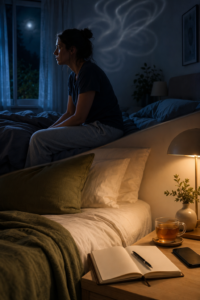
At 3 a.m., you may have fewer distractions and less ability to evaluate concerns calmly. You may also notice the time and immediately calculate how little sleep remains.
This can lead to thoughts such as:
- “Why am I awake again?”
- “Something must be wrong.”
- “I will not function tomorrow.”
- “I only have three hours left.”
- “What if I cannot fall back asleep?”
The awakening itself may be brief and normal. The anxious response to it can make it last longer.
If you wake during the night:
- Avoid checking the exact time.
- Keep the lighting dim.
- Do not begin working or planning.
- Relax your jaw and shoulders.
- Use gentle breathing or neutral imagery.
- Stay in bed if you remain calm and drowsy.
- Move to a quiet place if you become fully alert or frustrated.
- Return to bed when sleepiness develops again.
Avoid using your phone to research symptoms or calculate sleep cycles. Your 3 a.m. brain is an enthusiastic researcher but a questionable project manager.
Learn how to stop waking up at 3 AM and return to sleep more easily.
Nighttime Anxiety vs. Panic Attacks
Nighttime anxiety often develops gradually through worry, physical tension, and difficulty switching off your thoughts.
A panic attack usually involves a sudden surge of intense fear or discomfort. Symptoms may include:
- A racing heart
- Sweating
- Trembling
- Shortness of breath
- Chest discomfort
- Dizziness
- Nausea
- Tingling or numbness
- Feeling detached or unreal
- Fear of losing control
- Fear of dying
Panic attacks can occur before sleep or wake a person from sleep. These nighttime episodes are sometimes called nocturnal panic attacks.
Although panic attacks themselves are not usually life-threatening, their symptoms can resemble medical emergencies. First-time, severe, unusual, or unexplained symptoms should be medically evaluated rather than automatically attributed to panic.
If panic episodes recur, lead you to fear bedtime, or interfere with daily life, speak with a healthcare or mental health professional. Effective treatments are available.
Could a Medical Condition Be Contributing?
Anxiety symptoms and sleep difficulties may sometimes be affected by an underlying medical condition or medication.
Possible contributors can include:
- Thyroid disorders
- Menopause-related symptoms
- Chronic pain
- Acid reflux
- Asthma
- Sleep apnea
- Restless legs syndrome
- Low blood sugar
- Medication side effects
- Alcohol or substance withdrawal
Some prescription and over-the-counter products may also affect sleep or alertness, including certain decongestants, stimulants, corticosteroids, and medications taken at an unsuitable time.
Do not stop prescribed medication without professional guidance. Instead, ask your doctor or pharmacist whether the medication, dosage, or timing could be contributing to nighttime symptoms.
A medical evaluation is particularly important when anxiety begins suddenly, has no clear emotional trigger, or occurs with persistent physical symptoms.
How to Calm Anxiety at Night
Nighttime anxiety usually responds better to a combination of mental, physical, and behavioral strategies than to one perfect relaxation technique.
The following steps can help reduce alertness and make bedtime feel less threatening.
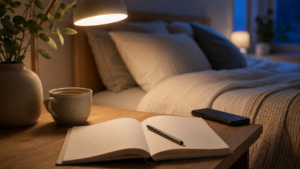
1. Write Down Your Worries Before Bed
Trying to remember unfinished tasks can keep them mentally active.
Set aside approximately 10 to 15 minutes earlier in the evening and write down:
- What is worrying you
- Whether you can take action
- The next practical step
- When you will address it
- What is currently outside your control
For example:
| Worry | Next step |
|---|---|
| Tomorrow’s meeting | Review notes at 9 a.m. |
| Medical question | Call the clinic tomorrow |
| Unpaid bill | Check the due date after breakfast |
| Difficult conversation | Write down two main points |
Keep the plan brief. Bedtime journaling should help you close the mental office, not open a night shift.
If the worry returns in bed, remind yourself:
“This has already been recorded. I can return to it tomorrow.”
2. Create a Predictable Wind-Down Routine
A consistent routine helps create a transition between daytime demands and nighttime rest.
Begin approximately 30 to 60 minutes before bed:
- Finish demanding work.
- Write down tomorrow’s priorities.
- Silence unnecessary notifications.
- Lower the lights.
- Take a warm shower or wash your face.
- Put on comfortable sleepwear.
- Read or listen to something calming.
- Go to bed when you feel sleepy.
The routine does not need to include expensive products or complicated rituals. Repeating a few calming activities in roughly the same order is more useful than designing an impressive routine that becomes another obligation.
3. Use Slow, Comfortable Breathing
Anxiety may cause faster breathing, muscle tension, and increased awareness of your heartbeat.
Gentle breathing can help settle this physical activation.
Try the following:
- Relax your jaw and shoulders.
- Inhale gently through your nose for four seconds.
- Exhale comfortably for six seconds.
- Continue for three to five minutes.
- Return to natural breathing if you feel uncomfortable.
The exact timing is not important. Avoid taking unusually deep breaths or forcing a rigid pattern.
Treat breathing as a way to become more comfortable—not as a test that must make you fall asleep immediately.
4. Release Physical Tension
Progressive muscle relaxation can redirect attention away from worry while helping you notice and release tension.
Beginning with your feet, gently tense one area for a few seconds and then let it relax.
Move gradually through:
- Feet
- Calves
- Thighs
- Stomach
- Hands
- Arms
- Shoulders
- Jaw
- Forehead
Use only mild tension. Skip any painful or injured area.
You can also simply scan your body and soften each area without tightening it first. Pay particular attention to the tongue, jaw, hands, and shoulders, where tension often remains unnoticed.
5. Stop Checking the Clock
Looking at the time can quickly turn wakefulness into a mathematical emergency.
You may begin calculating:
- How many hours remain
- How tired you will feel
- Whether tomorrow’s plans are possible
- How long a technique has taken
- Whether the night is already “ruined”
These calculations increase pressure without helping sleep.
Turn the clock away, keep your phone beyond reach, and avoid reviewing sleep-tracker data during the night.
You still need an alarm. You simply do not need live commentary on every minute you remain awake.
6. Respond Differently to Anxious Thoughts
Trying to eliminate every anxious thought can make you monitor your mind even more closely.
Instead, practice noticing the thought without immediately following it.
Use this sequence:
- Notice: “I am having an anxious thought.”
- Name: “This is worry about tomorrow.”
- Postpone: “I will address it during daytime planning.”
- Redirect: Return to your breathing, a neutral image, or a quiet activity.
Helpful reminders include:
- “A thought is not an emergency.”
- “I do not need to solve this from bed.”
- “Uncertainty is uncomfortable, but I can tolerate it.”
- “Rest still has value even if sleep takes time.”
- “I can respond to tomorrow when it arrives.”
- “This feeling will change.”
The thought may return several times. Gently redirecting your attention again is practice, not failure.
7. Leave the Bed if Anxiety Keeps Building
Staying in bed while increasingly anxious can teach the brain to associate the bedroom with worry and frustration.
Remain in bed if you feel calm and drowsy. However, consider getting up when you become:
- Fully alert
- Increasingly frustrated
- Tempted to start working
- Focused on the time
- Engaged in intense problem-solving
- Anxious about being in bed
Move to another comfortable place and keep the lights dim.
Choose a quiet activity, such as:
- Reading a calm printed book
- Listening to gentle audio
- Practicing relaxed breathing
- Folding a few clothes
- Completing a simple paper puzzle
- Sitting quietly
Avoid work, upsetting news, social media, online shopping, and symptom searches.
Return to bed when you notice genuine sleepiness, such as heavy eyelids, yawning, or difficulty concentrating on what you are reading.
8. Reduce Late-Night Reassurance Seeking
Anxiety often creates a strong desire for certainty.
You may repeatedly:
- Search symptoms online
- Ask someone whether everything is okay
- Review messages or conversations
- Check doors and appliances
- Monitor your heartbeat
- Examine tomorrow’s schedule
- Read the same information several times
Reassurance may provide short-term relief, but frequent checking can teach the brain that the worry requires an immediate response.
Before checking, pause and ask:
“Is there a genuine action I need to take now, or am I trying to obtain complete certainty?”
If there is no urgent action, record the concern and postpone further checking until daytime.
Do not ignore genuine safety or medical concerns. The aim is to reduce repetitive checking, not to dismiss important problems.
A 10-Minute Routine for Nighttime Anxiety
Use this short routine before getting into bed or when anxiety begins during your wind-down period.
Minutes 1–3: Record the Concern
Write down:
- The main worry
- Any unfinished task connected to it
- One realistic next action
- When you will take that action
Avoid writing a detailed analysis of every possible outcome.
Minutes 4–6: Relax the Body
Release tension from your:
- Forehead
- Jaw
- Tongue
- Shoulders
- Hands
- Stomach
- Legs
Take several slow, comfortable breaths with a slightly longer exhalation.
Minutes 7–10: Use Neutral Attention
Focus on something calm and emotionally neutral, such as:
- Rain against a window
- Leaves moving in the wind
- Waves reaching an empty beach
- Books arranged on a shelf
- Clouds slowly crossing the sky
- Unrelated objects beginning with the same letter
If anxiety returns, acknowledge it and gently return to the neutral image.
When the ten minutes end, go to bed if you feel sleepy. If you remain alert, continue a quiet activity in dim light.
Daytime Habits That May Reduce Nighttime Anxiety
What you do during the day can influence how your nervous system behaves at night.
Get Morning Light
Spend time outdoors after waking when possible. Morning light supports the circadian rhythm and helps reinforce the difference between daytime alertness and nighttime rest.
Keep a Consistent Wake Time
Wake at approximately the same time each day, even after a difficult night.
Sleeping several hours later may provide temporary relief but can delay sleepiness the following evening.
Exercise Regularly
Walking, cycling, swimming, resistance training, and yoga may help reduce stress and build sleep pressure.
If vigorous evening exercise makes you feel more alert, schedule it earlier.
Reduce Late Caffeine
Move coffee, tea, energy drinks, and other caffeinated products earlier in the day if nighttime anxiety is accompanied by restlessness or a noticeable heartbeat.
Remember that caffeine sensitivity differs from person to person.
Process Stress Before Nighttime
Give difficult concerns some attention while you still have the energy to respond effectively.
Schedule time during the day for:
- Planning
- Financial tasks
- Important conversations
- Medical questions
- Work organization
- Emotional reflection
- Preparing for appointments
This does not guarantee that worries will disappear, but it reduces the chance that bedtime becomes their first available meeting slot.
Limit Alcohol as a Coping Strategy
Alcohol may initially make you feel sleepy, but it can disrupt sleep later in the night and may worsen anxiety for some people as its effects wear off.
Using alcohol regularly to manage anxiety or induce sleep can also create additional health risks. Speak with a professional if reducing alcohol feels difficult or causes withdrawal symptoms.
What Not to Do During Nighttime Anxiety
Try to avoid:
- Repeatedly checking the time
- Searching every symptom online
- Reading work messages in bed
- Beginning an emotionally difficult conversation
- Using alcohol as a sleep aid
- Taking extra medication without guidance
- Going to bed much earlier than usual
- Remaining in bed while increasingly frustrated
- Canceling all activity after one poor night
- Judging your health by one night of sleep-tracker data
You do not need to respond perfectly. Choose one or two patterns to change first.
When to Seek Professional Help
Consider speaking with a healthcare or mental health professional when nighttime anxiety:
- Occurs most nights for several weeks
- Feels uncontrollable
- Regularly prevents sleep
- Produces recurring panic attacks
- Causes substantial daytime fatigue
- Interferes with work or relationships
- Leads you to avoid bedtime
- Causes frequent reassurance seeking
- Is connected to trauma or compulsive behavior
- Occurs with persistent sadness or hopelessness
- Leads to reliance on alcohol or sleeping medication
- Continues despite consistent self-help strategies
Treatment may include therapy for anxiety, stress-management support, medical evaluation, medication when appropriate, or cognitive behavioral therapy for insomnia.
Seek urgent help if you experience thoughts of self-harm, feel unable to remain safe, or believe you are experiencing a medical emergency.
Can CBT-I Help With Nighttime Anxiety?
Cognitive behavioral therapy for insomnia, or CBT-I, addresses thoughts and behaviors that maintain persistent sleep difficulty.
Depending on your situation, CBT-I may help you:
- Reduce anxiety about not sleeping
- Rebuild the association between bed and sleep
- Stop spending prolonged periods awake in bed
- Maintain a steadier sleep schedule
- Reduce clock-checking
- Respond more calmly to nighttime awakenings
- Challenge catastrophic beliefs about poor sleep
CBT-I is more structured than general sleep-hygiene advice. If anxiety also occurs throughout the day, treatment may need to address both insomnia and the underlying anxiety.
Final Thoughts
Understanding why anxiety gets worse at night can make the experience feel less mysterious and threatening.
Anxiety may become more noticeable when distractions disappear, stress remains unprocessed, mental fatigue reduces emotional control, physical sensations receive more attention, or previous sleepless nights create fear around bedtime.
Start with practical changes: write down worries earlier, reduce late caffeine and stimulating content, keep a consistent wake time, stop checking the clock, and leave the bed when frustration builds.
You do not need to create a perfectly empty mind. The more realistic goal is to show your brain that anxious thoughts can be noticed without being investigated, solved, and presented as breaking news at midnight.
Frequently Asked Questions
Why does anxiety suddenly appear at night?
Daytime distractions may keep anxiety in the background. When the environment becomes quiet, unresolved worries, physical sensations, and stress can become more noticeable.
How can I calm anxiety quickly at night?
Write down the concern, relax your jaw and shoulders, breathe slowly, avoid checking the time, and redirect your attention toward a neutral image or quiet activity.
Should I stay in bed when I feel anxious?
Stay if you remain calm and drowsy. If you become fully alert, frustrated, or increasingly anxious, move to a dimly lit area and return when you feel sleepy.
Can caffeine cause nighttime anxiety?
Yes. Caffeine may contribute to restlessness, a noticeable heartbeat, shakiness, racing thoughts, and delayed sleep. Its effects and duration vary between individuals.
Why do I feel anxious after waking at 3 a.m.?
The quiet environment, reduced emotional control, clock-checking, and fear of losing sleep can make ordinary nighttime awakenings feel threatening.
Can nighttime anxiety cause panic attacks?
Yes. Panic attacks may occur before sleep or awaken someone from sleep. First-time, severe, or unusual symptoms should be medically evaluated because they can resemble other conditions.
Is nighttime anxiety an anxiety disorder?
Not necessarily. Temporary anxiety can occur during stressful periods. Professional evaluation may be appropriate when symptoms persist, feel uncontrollable, or interfere with sleep and daily functioning.
When should I speak with a professional?
Seek guidance when nighttime anxiety occurs frequently for several weeks, causes significant sleep loss, triggers panic, affects daily life, or occurs with depression, trauma symptoms, substance use, or thoughts of self-harm.
Related Guides
How to Stop Overthinking at Night: 9 Calming Tips
How Does Stress Affect Sleep? 7 Ways to Sleep Better